Tuesday, October 27, 2020

Closest ancient DNA

 Closest ancient DNA


Distance to: Armenian

0.03104339 AZE_Caucasus_lowlands_LN

0.03456153 IRN_Hajji_Firuz_C

0.04017568 IND_Roopkund_B_o

0.04442962 TUR_Arslantepe_EBA

0.04911677 TUR_Arslantepe_LC

0.04920759 ARM_Areni_C

0.04925681 Kura-Araxes_ARM_Talin

0.04954564 IRN_Hasanlu_IA

0.05142391 TUR_Ikiztepe_LC

0.05346867 TUR_Alalakh_MLBA

0.05365388 Kura-Araxes_ARM_Kalavan

0.05566419 Levant_Megiddo_MLBA_o1

0.05646336 Kura-Araxes_ARM_Kaps

0.05792011 TUR_Titris_Hoyuk_EBA

0.05807041 IRN_Ganj_Dareh_Historic

0.05914986 TUR_Ovaoren_EBA

0.05978435 TUR_Barcin_C

0.05994256 IRN_Hajji_Firuz_IA

0.06006864 RUS_Maykop_Late

0.06068718 SYR_Ebla_EMBA

0.06076711 TUR_Kaman-Kalehoyuk_MLBA

0.06133420 Levant_LBN_MA

0.06182855 Levant_LBN_Roman

0.06183801 AZE_Caucasus_lowlands_LC

0.06380430 RUS_Maykop

The history of J2-M67.

M67 is the most popular type of J2 among Armenians so lets understand it's origin.

M67 is 12.000-year-old and has three different subclades each of them has a different distribution.

1/ Y4036 and Z467 is a large, diffused branch found in Europe and West Asia. It rare in Caucasus. It is particularly frequent among Armenians also. It was found in many sites of Bronze Age Anatolia, some of them in possible Hittite layers. Genome wide they were shifted to East. It was also found in Italian Neolithic which is very surprising because in the rest of Neolithic Europe it was absent. This probably means different origin of Cardial ware Italian Neolithic. In ancient Armenia it was found from Beniamin.

2.a/ Z500>M92 This is the most frequent type of M67 among Armenians. It is not frequent among Caucasians. Except in Pontic region and parts of southwestern Georgia. We have few aDNA with M92 but judging its structure and age it's expected to be a Kur-Araxian marker. The presence of M92 in Kura-Araxes site in eastern Georgia (Doghlauri) support this theory. It was found in Bronze Age Levant and medieval Sudan.  In ancient Armenia we have M92 from a site near the village Shnogh (Lori).

2.b/ Z500>Y6240   This branch was found in Bronze Age Crete. In Arslan Tepe and Alalakh. Another young Iron Age branch (Z28602, 2800-year-old) is found predominantly in eastern Pontic region in Hamshen Armenians. 

3.a/ Z7671>CTS900 Is found predominantly among Caucasian people. Reaching the highest levels in the world among Nakh people (the Y3640). This peak is a result of young founder effect related to the breakup of proto Nakh community. It was found in Eneolithic Meshoko-Darkveti culture in Maykop culture which succeeded it. It migrated there from south which is confirmed by their autosomes. It was also found in LBA Hungary. Most probably it reached there via Steppe. This branch is present in Armenia with its own subclades.

3.b/ Z7671>V2639 This subbranch was found in Bronze Age Crete. It is also present in Nakh people which speaks in favor of its Chaff faced ware origin.

Conclusion. The M67 homeland was in historic Armenia. More precisely in its western / northwestern part. Z467 migrated to West. CTS900 migrated to North, the M92 expanded in Bronze Age most probably with Kura-Araxes culture.

See also 


North Caucasian genetics - The source of Steppe ancestry

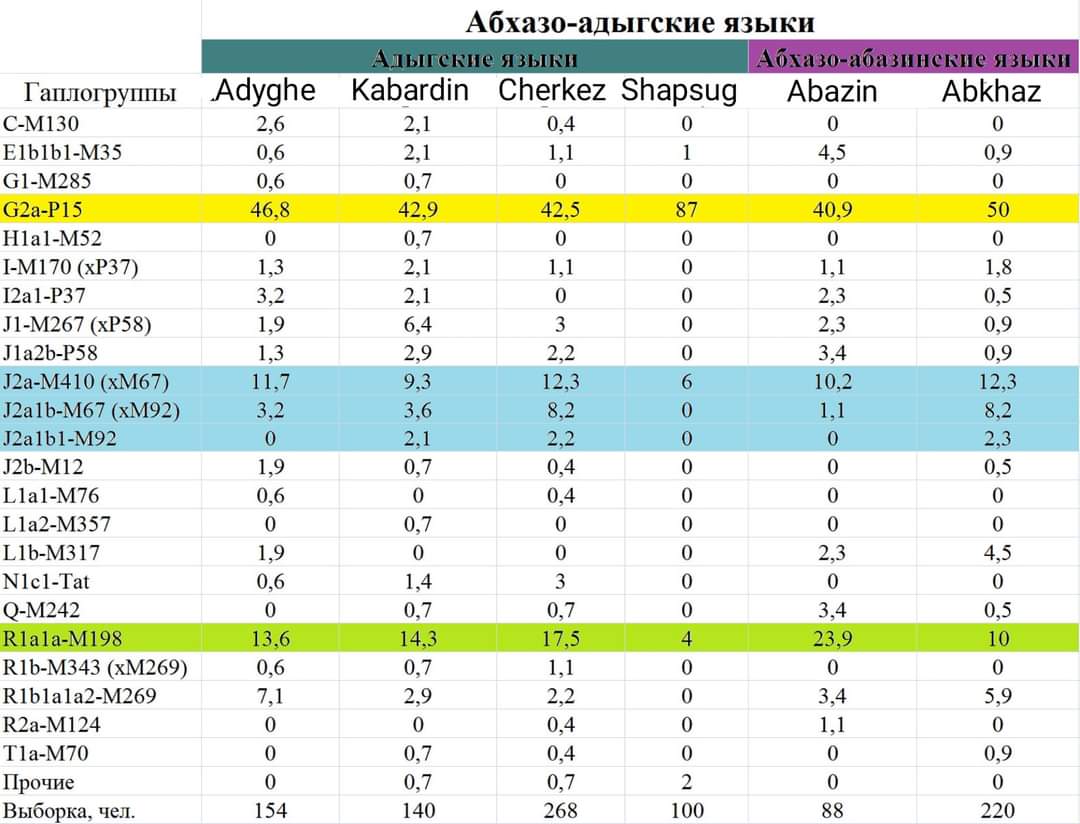
Let's discuss the origins of Steppe ancestry in Northwest Caucasian (NWC) people also known as Abkhaz-Adyghean family. Here is a quote from Wang paper.


First, sometime after the BA present-day North Caucasian populations must have received additional gene-flow from steppe populations that now separates them from southern Caucasians, who largely retained the BA ancestry profile. The archaeological and historic records suggest numerous incursions during the subsequent Iron Age and Medieval times33, but ancient DNA from these time periods will be needed to test this directly. 


Indeed, we have a Dolmen LBA sample which do not have steppe ancestry despite the fact that it is a prime candidate of being Proto NWC culture. Modern NWC do have steppe ancestry (except Abkhazians) mostly from a Scythian source, this after LBA. The presence of R1a in NWC reinforce this idea. Also, they have East Asian ancestry from medieval Turkic populations. In the picture attached it is called MNG_Early_Xiongnu. And some minor Yamna related ancestry which is called Kubano-Tersk. The low level of direct Yamna ancestry in Northwest Caucasus is not surprising given that R1b Z2103 is less frequent than R1a Abkhaz-Adyghean people. Interestingly NWC people do not have any ancestry from Steppe Maykop, which should not be confused with Mountainous (Caucasus) Maykop.

Most ancestry in NWC people is from MBA North Caucasus sample from Kudachurt. It has virtually no Steppe ancestry, and genome wide it is close to Eneolithic period Darkveti Meshoko. I couldn't use Dolmen LBA because it is absent in the G25 calculator. In most likelihood the extra Anatolian farmers related ancestry (Bulgaria_Chl) that NWC people had is related to Bronze Age Dolmen culture. The alternative explanation is the Colchian culture. The extra Anatolian shift could be related to high level of G2a2b in Northwest Caucasus. What is the origin of Y DNA G2a2-U1>L1264 prevalent in NWC people is not clear but ancient DNA almost certainly will help to solve this puzzle.

See also


The Hajji Firuz BA sample dated to 2300 bce was found accidently in Eneolithic layers

 The Hajji Firuz BA sample dated to 2300 bce was found accidently in Eneolithic layers. It was published in Naramsimhan paper about South Asia and was recognised as having a steppe ancestry. Indeed she has and a lot. Offcourse this do not mean that this type was widespread. We simply need more samples.


Target: IRN_Hajji_Firuz_BA

Distance: 2.1202% / 0.02120195

55.8 Yamnaya_RUS_Samara

21.2 IRN_Hajji_Firuz_C

13.2 Anatolia_Tepecik_Ciftlik_N

9.8 RUS_Darkveti-Meshoko_En


This period in that Urmia region is the end of Kur Araxian culture end emergence of new potteries. One is called Urmia ware ( it is equivalent to Karmir Vanq ) which has connection to contemporary sites in South Caucasus. The other one is the Khabur ware from North Mesopotamia.

This paper is in Persian. It has two interesting maps. One of them represents the Middle Bronze Age.


Below is the abstract in English.


Explaining the Middle and Late Bronze Age Cultures of North-Western Iran, Case Study: Urmia Ware and Khabur Pottery

Authors

Rahim velayati 1 saeed mirzaee 2 Hamid khanali 

1 Assistant Professor Department of Archaeology - University of Tehran


Abstract


The 2nd and 1st millennium B.C., have a special attraction for archaeologists due to the advent of widespread commercial relations and urbanization parameters, establishing an initial city-state and then the governments and creation of the empires. The 2nd millennium B.C. is known as the Bronze Age in Iranian archaeological literature. The Bronze Age is beginning from 3000 BC to 1500 B.C., divided into three shorter periods of Early, Middle and Late Bronze Ages. Early Bronze Age is known as Kura Araxes in the northwest of Iran. In the 3rd millennium BC, Kura-Araxes culture included vast part of the Caucasus, North-West, Zagros and Northern Plateau of Iran, the east and south of Anatolia, north of Mesopotamia, and Levant’s areas in the east of Mediterranean which suddenly collapsed due to several factors. Following the collapse of these areas in the late 3rd millennium B.C., the Culture of the painted pottery flourished in the 2nd millennium B.C. After destruction of this culture during later phases (Middle and Late Bronze Age, 2nd millennium B.C.), nomadism expanded comprehensively in northwestern Iran, Transcaucasia and Eastern Anatolia. According to chronology of Middle Bronze Age, there are two distinct types of pottery in this area; Urmia and Khabur styles. The first one found in the Haftvan Tepe VI B. Edwards invented for first time Terminology of “Urmia style” after excavation of Haftvan Tepe VI B, however, he said it was Stronach’s suggestion. According to the archaeological findings, the tradition began at ca. 2200 B.C. and ended at northwestern Iran, eastern Anatolia ca. 1300 B.C.; however, some researchers believed it expanded from the Qazvin plain (Sagzabad Tepe) to the southern Caucasia and near Erzurum in Turkey. Characteristically, Urmia pottery is a painted monochrome or polychrome ware on red or dark orange background. The motifs of this culture are generally geometric subdivided into Van-Urmia, Tazehkand (Karmirbird), Sevan-Uzerlik Tepe, Tray mountain and Sagezabad cultures. The latter form, Khabur, first time suggested by Melvin fowler to introduce the pithos with geometric and striped motif and Opaque colored found from Khabur Plain. It is characteristically buff ware with black or dark brown geometric or animal motifs. The Khabur wares expanded in vast area, from West and Northwest of Iran, Northern Mesopotamia, Syria and south of Anatolia, whereas Mardin region is known as the entrance gate of Khabur wares into Anatolia. This type of pottery has been dated between 1900 and 1600 B.C. in northern Mesopotamia and also between 2106 ± 68 and 1684 ± 58 B.C. by Thermoluminescent method in Dinkhah Tepe (Northwest of Iran). Khabur style was discarded and replaced by Nuzi pottery at the beginning of Late Bronze Age, but the Urmia style continued in the northwest of Iran, the Caucasia and East of Anatolia until the beginning of Iron Age. There is not much difference between Middle and Late Bronze Ages especially in subsistence strategies and the nature of settlements. The only significant difference is the advent and expansion of polychrome technique and new realistic naturalistic animal and human motifs. Some new forms of pottery appeared in Late Bronze Age including thin bowls with vertical bodies, double-angled wares and boot-shaped rhytons. In this article, there is an attempt to study the expansion of Urmia and Khabur Styles, Intra-regional features, and mutual and inter-regional relations during 2nd millennium BC.Conclusions indicate that the Bronze Age cultures, especially Khabur Style is very important due to the expansion of trade during the period, therefore, the cultures of Urmia and Khabur expanded in Caucasia, East of Turkey, North of Iraq, west and northwest of Iran during this period.

We have discussed recently autosomes.


We have discussed recently autosomes. So, let's compare some modern and ancient populations with a very simple tool called vahaduo.

Target: Armenian
Distance: 1.5158% / 0.01515807
60.4 IRN_Hajji_Firuz_C
17.4 Anatolia_Tepecik_Ciftlik_N
14.0 Kura-Araxes_ARM_Talin
7.0 Yamnaya_RUS_Samara
1.2 RUS_Darkveti-Meshoko_En

Target: Kurdish
Distance: 1.6204% / 0.01620444
45.8 IRN_Hajji_Firuz_C
25.8 TKM_Gonur1_BA
17.2 Anatolia_Tepecik_Ciftlik_N
11.2 Yamnaya_RUS_Samara


Target: Georgian_Imer
Distance: 2.3262% / 0.02326166
64.4 RUS_Darkveti-Meshoko_En
23.0 Kura-Araxes_ARM_Talin
12.6 Anatolia_Tepecik_Ciftlik_N

Target: Assyrian
Distance: 1.8124% / 0.01812432
77.8 IRN_Hajji_Firuz_C
14.0 Anatolia_Tepecik_Ciftlik_N
7.0 Yamnaya_RUS_Samara
1.2 TKM_Gonur1_BA

And now some ancient pops.


Target: ARM_LBA (Etiuni)
Distance: 2.2611% / 0.02261111
36.2 IRN_Hajji_Firuz_C
29.4 Yamnaya_RUS_Samara
20.8 Kura-Araxes_ARM_Talin
7.8 Anatolia_Tepecik_Ciftlik_N
5.8 RUS_Darkveti-Meshoko_En

Target: ARM_Lchashen (Etiuni)
Distance: 2.1067% / 0.02106658
46.8 IRN_Hajji_Firuz_C
26.2 Yamnaya_RUS_Samara
22.4 Kura-Araxes_ARM_Talin
2.4 Anatolia_Tepecik_Ciftlik_N
2.2 RUS_Darkveti-Meshoko_En

Target: IRN_Hasanlu_IA
Distance: 2.7997% / 0.02799672
58.6 IRN_Hajji_Firuz_C
17.8 TKM_Gonur1_BA
10.0 Yamnaya_RUS_Samara
8.6 Anatolia_Tepecik_Ciftlik_N
5.0 Kura-Araxes_ARM_Talin


As one can see despite broad similarities those nations are different. Georgians do prefer Darkveti Meshoko a Caucasian culture. While the main difference between Kurds and Armenians is the strong presence of Central Asian BMAC ancestry among Kurds which is absent among Armenians. In usual ADMIXTURE runs this BMAC ancestry is visible as ASI. And this is the most surprising result of DNA. All talks of massive Iranian ancestry in Armenia are exaggerated!

Now you may say but Armenians have a lot of Iran Hajji Firuz Chl. Well, that is true but this a 7000 Neolithic farmer sample that came from Fertile Crescent from West (modern Iraqi Kurdistan). That is why Armenians and Assyrians have the highest affinity to this type of ancestry.

The mainstream is that Sintashta culture is a Indo Iranian culture.

 The mainstream is that Sintashta culture is a Indo Iranian culture. So why do You think no single Indo Iranian is close to this Sintashta.


Почему по вашему ни один индо иранский народ не близок к предпологаемой прото индо иранской культуре? Ваше мнение.


Rise395 Eurasian Steppes Sintashta (1860 BC)


1. North_Swedish (7.883)

2. Swedish (11.08)

3. Southwest_Finnish (11.46)

4. Norwegian (11.57)

5. Danish (12.70)

6. German_Central (12.88)

7. West_Norwegian (13.15)

8. North_German (13.30)

Tuesday, February 25, 2020

This important paper of Kossian

This important paper of Kossian is now available online. He says what I am advocating many years based on genetic data. 
The Mushk attested in Assyrian texts in Early Iron Age were not migrants from Balkanes but migrants from Armenian Highlands/East Anatolia/ , South Caucasus. Their deep origins must be in Trialeti Vanadzor culture and LBA Transcaucasia (today Lchashen Metsamor is used) . 
From genetic point of view I2c2 must be their haplotype. Also it is possible that R1b L277 and maybe few cases of E-V13 were introduced to Armenia by them in Middle Late Bronze Age via Caucasus. Then later in EIA they expanded toward west Malatya Kharberd regions. Also, some groups affiliated to them moved to Urmia region in NW Iran.