Showing posts with label Y-DNA. Show all posts

Saturday, March 7, 2026

Genetic history of H2-P96

Based on the current stage of our knowledge, the homeland of H2-P96 was in the "core area" of the Fertile Crescent. From the region near modern Urfa - Diyarbekir, it expanded in different directions, carried by the early Neolithic farmers. H2-P96 has been found in ancient Anatolia and Europe, in the Levant and Egypt, and in South Caucasian Neolithic sites. Currently, there is no evidence that H2 moved eastward to Central Asia or South Asia.


This may sound counterintuitive, but the story of H2 is unrelated to H1, which is prominent in South Asia and India. The common ancestor of H2 and H1 lived 45,000 years ago, during the out-of-Africa dispersal wave. The ancestor of H2 remained in West Asia, while the ancestor of H1 appears to have been present in India since the Upper Paleolithic period. Currently, there is no evidence that H1 was related to the Zagros Neolithic farmers.

The three main directions of the Neolithic spread of H2 are somewhat similar to the story of T1a1. Due to poor resolution of many academic papers its impossible currently to reconstruct the story of H2 and its subclades with hugher precision.  That is why we will use just the generic P96 level. Which by the way has a TMRCA more than 16.000 yeaes.

  • Anatolia and Europe: H2 moved into Europe from Anatolia with the early farmers. Despite some rumours of H2 presence in Paleolithic Europe—which still require solid confirmation—it is obvious that virtually all H2 found in early Neolithic cultures of Europe came from Anatolia.
  • Levant and Africa: H2 was found in the PPNB period of the Levant. From there, it moved to Egypt. An ancient priest's mummy DNA analysis revealed H2 Y-DNA.
  • Historic Armenia and the Caucasus: H2 was found at the Shulaveri culture site of Aruchlo in Georgia. It reached the Caucasus via historic Armenia. H2 is quite diverse among modern Armenians. Overall, H2 is rare in modern populations, except in a few cases. One such case is among Armenians, where it is found at non-trace (low but noticeable) levels.


Friday, November 15, 2024

A Broader View of Eurasian Genetic History

A Broader View of Eurasian Genetic History

This group is dedicated to Armenians, but since many topics discussed here are indirectly related to Indo-European (IE) and therefore to Armenian origins, it is useful to take a broader view of Eurasian genetic history. Another reason to discuss East Asian genetics is that two of Armenia’s neighboring countries speak Turkic languages, whose origins lie in that region.

After the initial spread of modern humans across Eurasia around 45,000 years ago, populations gradually divided into two broad groups:

  • East Eurasians, living east of the Himalayan region

  • West Eurasians

Initially, these populations were genetically quite similar, as confirmed by ancient DNA studies. However, after the Last Glacial Maximum (around 20,000 years ago), a new and more genetically drifted population formed in East Asia, associated with what is historically described as the Mongoloid phenotype. This development occurred primarily through local evolution and genetic drift, rather than large-scale migration.

Today these populations are often described as belonging to the Mongoloid anthropological group, while West Eurasians are traditionally described as Caucasoid (Europoid).

Origins of East Asian Ancestry

East Asian ancestry likely formed in the region of northern China and the Amur basin. The main Y-DNA haplogroups associated with these populations include:

  • N

  • O

  • C2

(See the attached maps.)

Another important lineage is haplogroup Q, which existed in Paleolithic Siberia and had West Eurasian origins. This lineage was associated with the population known as Ancient North Eurasians (ANE), a genetic group that no longer exists in its original form today.

Formation of Native American Populations

Native Americans (Amerindians) formed through a mixture of ANE populations and early East Asian populations in the Far East. Despite this mixture, their dominant Y-DNA lineage remained the western-derived haplogroup Q1. These populations entered the Americas approximately 15,000 years ago.

Expansions from East Asia

At various points, several technological and cultural innovations gave East Asian populations significant demographic advantages.

One notable example is pottery production. Some of the earliest known pottery comes from the Amur region and northern China, dated to roughly 12,000–18,000 years ago.

Later expansions were associated with particular Y-DNA lineages:

  • Around 7,000–8,000 years ago, haplogroup N spread from Mongolia into Siberia, initiating a major migration that eventually reached northern Europe and Finland. Today, haplogroup N is most common among Uralic-speaking populations, whose homeland likely lay east of the Ural Mountains. Some Turkic-speaking groups also carry this lineage, though generally at lower frequencies.

  • The expansion of haplogroup O is closely associated with the development of agriculture in China, including both rice farming in southern China and millet farming in northern China. These farming populations expanded southward, largely replacing earlier populations related to Australo-Melanesian groups such as the Onge, Papuans, and Australian Aboriginal peoples.

  • Finally, haplogroup C2, originally restricted to the Amur region, expanded dramatically during the historical period, especially in connection with Mongolic and Tungusic-speaking populations, including the Evenks.

Linguistic Families Expanding from East Eurasia

Several major linguistic families originated in East Eurasia and spread both languages and genetic ancestry across large parts of the world. The autosomal impact of these expansions can be seen in the fourth map. Although such maps may slightly exaggerate the extent of these influences, they provide a general impression of the scale of these demographic movements.

The main language families involved include:

  • Uralic

  • Turkic

  • Mongolic

  • Tungusic (Evenk)

  • Sino-Tibetan (whose most famous representative is Chinese)

  • Austroasiatic, which expanded as far as India

  • Austronesian, which spread from Madagascar across Indonesia to Easter Island in the Pacific

I will dedicate separate threads to some of these linguistic families that are particularly relevant to Armenian history.


Tuesday, September 10, 2024

The haplogroup G

 The haplogroup G is the third most frequent in Armenia after R1b and J2.

G was prominent in early Neolithic farmers, especially in those that moved to Europe. Despite its popularity in West Caucasus Rootsie 2012 analyzed the modern diversity of G and made this conclusion about its homeland.

..by evaluating 1472 haplogroup G chromosomes belonging to 98 populations ranging from Europe to Pakistan. Although no basal G-M201* chromosomes were detected in our data set, the homeland of this haplogroup has been estimated to be somewhere nearby eastern Anatolia, Armenia or western Iran, the only areas characterized by the co-presence of deep basal branches as well as the occurrence of high sub-haplogroup diversity. ...

In the last decade ancient DNA supported this homeland theory with a slight shift to more southern regions toward Fertile Crescent.

Three branches are frequent in Armenia.
  • G2a2b-M406 more than 3.5%
  • G2a2b-P303 around 3%
  • G2a2a-PF3147 around 2.5%
Other branches are less frequent.
  • G2a1
  • G1 prominent in Hamshen Armenians
  • Over time there will be reviews about those branches.


Monday, September 9, 2024

Iron Age Y-DNA from North Macedonia

Iron Age Y-DNA from North Macedonia

This dataset shows Iron Age Y-DNA samples from the territory of modern North Macedonia, based on data from Iosef Lazaridis et al. (2022). Two outlier individuals are not included in the chart.

These populations were identified in Greek historical records as the Paeonians.

The haplogroups present in these samples reflect several different historical layers:

  • G2, C1, and J2a-Z6055 derive from Neolithic populations.

  • R1b reflects ancestry connected with Yamnaya culture expansions.

  • E1b-V13 is associated with Thracian-related expansions from the Carpathian region around 1000 BCE.

Based on the current data, the Paeonians were unlikely to have been closely related to the Illyrians, since the characteristic J2b-L283 haplogroup, commonly associated with Illyrian populations, is absent.

Instead, they may have been closer to populations such as the Phrygians and the Ancient Macedonians. A connection with the Thracians is also possible, though somewhat less likely.

An older and now obsolete theory proposed a Paei → Hai sound shift as evidence for a migration of Proto-Armenians from the Balkans. However, this interpretation is no longer supported by current historical and genetic evidence.

Nevertheless, Armenians and Paeonians remain related in a broader sense, both as members of the Indo-European languages, and through shared Neolithic ancestry reflected in the genetic record.

Saturday, July 20, 2024

The J2 haplogroup has a complex structure.

The J2 haplogroup has a complex structure. For those who want to understand it better here is a tree made by Rozhansky more than 6 years ago. We have already four detailed topics related to each major subbranch. Top four of most popular J2 branches in Armenia.


Other interesting branches are the
  • +Z6049 found in Caucasian hunters. Popular today in Caucasus. A review about one of its subclade.
  • +PF5197 found in India, Iran and Gulf region. Also, in ancient Neolithic Armenia.
  • +M319 Popular in ancient Crete in Minoans. But also, in Eneolithic steppe.
The populations from left to right are Nakh, Balkar, Ossetian, Georgian, Armenian.
Updated in 2024 July


Wednesday, July 17, 2024

J2-Z6065 in the Armenian Highlands

J2-Z6065 in the Armenian Highlands

J2-Z6065 is the third most frequent branch of J2a in Armenia, after M67 and L25. Its initial homeland was almost certainly located in historic Armenia.

At present, the oldest known Z6065 sample comes from the Neolithic site of Masis Blur in Armenia. Notably, this lineage is absent among early Anatolian and European farmers and is rare or missing in ancient Minoan populations, suggesting that Z6065 had a slightly more eastern origin compared to related branches such as M67 and M319, with which it shares a common ancestor.

J2-Z6065 has two major sub-branches:


1. Y13341 / FGC15782

Like many lineages that formed in the Armenian Highlands, Z6065 appears to have expanded during the Chalcolithic period, moving westward into Anatolia. It has been identified at sites such as Ilipinar in Anatolia and Dinkha Tepe in the Urmia basin.

However, its most significant expansion occurred during the Middle Bronze Age (around 4300 years ago).

  • The subclade Z6065 > YP879 was likely associated with the Van–Urmia cultural sphere and expanded alongside it, as well as with the related Karmir Berd culture.
  • This lineage has been identified in the Urartian city of Sardurihinili and in Late Bronze Age Keti (modern Armenia).

Today, YP879 accounts for approximately 2.5% of the Y-DNA among modern Armenians.


2. Y7687

This sub-branch likely followed a broadly similar early trajectory but diverged through different historical processes.

  • The subclade Z43661 is most likely associated with Bronze Age Anatolia, and there is a strong possibility that it represents a Hittite–Luwian–related lineage.
  • Ancient DNA evidence from the Bronze Age site of Ovaören supports this hypothesis.

Today, this branch is well represented in both Turkey and Armenia.

A distinct lineage within this branch, M47, shows a very different geographic distribution, being most prevalent among Gulf Arab and Iranian populations.

  • M47 expanded during the Bronze Age, but also shows evidence of later expansions.
  • The historical context of these expansions remains unclear due to the lack of ancient DNA.
  • One possible hypothesis is that M47 was initially associated with the Kassites, and later became integrated into Iranian and Semitic populations.

Conclusion

Overall, J2-Z6065 appears to be a lineage deeply rooted in the Armenian Highlands, with multiple expansion phases:

  • Chalcolithic dispersals toward Anatolia and adjacent regions
  • Middle Bronze Age expansions tied to local cultural complexes (e.g., Van–Urmia)
  • Later regional developments, especially in Anatolia and the Near East

Further ancient DNA discoveries will be essential to clarify the full historical trajectory of its subclades.

Saturday, April 27, 2024

Pastoralism in East Europe

We have now quite large number of samples before the Yamnaya period in East Europe ( before 3300BC) to have some conclusions about the origins of pastoralism in Pontic Caspian steppe and forest steppe regions.

If we keep aside local hunter gatherer lineages and those associated with Maykop culture in North Caucasus, then we are left with haplotypes that are associated with South Caucasian farmers. Shulaveri Aratashen culture.
  • J2-M319 - an obvious farmer lineage, which usually is associated with Minoans but it's deeper origins are without doubt in historic Armenia. Absent in European farmers.
  • J2b2b from Eneolithic Moldova associated with migrations from east. This branch was never found in any Euro-Anatolian farmer site but was found in Mentesh tepe in northwest of Azerbaijan.
  • J2b2a1-L283 currently the oldest sample from this branch is from Yamnaya but there is little doubt that it was present in Eneolithic steppe also. It became part of Yamnaya communities, moved to west Balkans and had a successful founder effect there. It's parallel branch the J2b2a2 is a lineage found in farmers from Central Asia who from there moved to India. Thus, indirect evidence supports that it was a south Caucasian farmer lineage. Its hunter gatherer origin is less likely.
  • J1b - it was a west Caucasian hunter lineage. It could be a CHG lineage in steppe. But a farmer lineage can't be ruled out completely given that this branch was found in many farmers sites stretched from Pakistan to Crete. In steppe it was found in Volga region and Usatovo cultures.
  • J1-CTS1026 - similar to J1b uncertain affiliation. It's south Caucasian origin in steppe is without doubt.
Besides those cases there were also J1* in Karelia in hunter gatherer context. Those were almost certainly from CHG.
On the other hand, there was no single European farmers lineage found in Pontic Caspian steppe. Archaeologists believed that west Ukraine farmers played an important role in the introduction of pastoralism, but the genetic data do not support that idea. In west Ukraine Cucuteni Trypllia farmers we have G2a2a, G2a2b, E1b-L618, C1a2, I2a2a etc. None of them is found in steppe.
An unpublished sample from Nalchik proves that farmers from South Caucasus moved to north. Despite this southern input, the Eneolithic steppe was predominantly R1b-V1636 and I2-L699. This latter was a Ukraine hunter gatherer lineage in its deep origin.
What was the reason of the mismatch between autosomes and Y DNA is hard to say but a similar scenario occurred in main Europe where after an initial success, the G2 farmers lost their positions and I2 became more frequent. While the autosomes didn't change in a significant manner.
Those genetic results is supported by the linguistics data also. Sahala notice that the Sumerian word gud, gu meaning ox, bull is a good parallel with PIE *gou(s) meaning cow, ox. From which the Armenian word kov is derived.
Matasovic notice that the reconstructed PIE language morphology shares features with North Caucasian languages.
PS You can see the Caucasus Lower Volga cline on the map which had both CHG and South Caucasian farmers ancestry mixed with local hunter gatherers


Tuesday, December 5, 2023

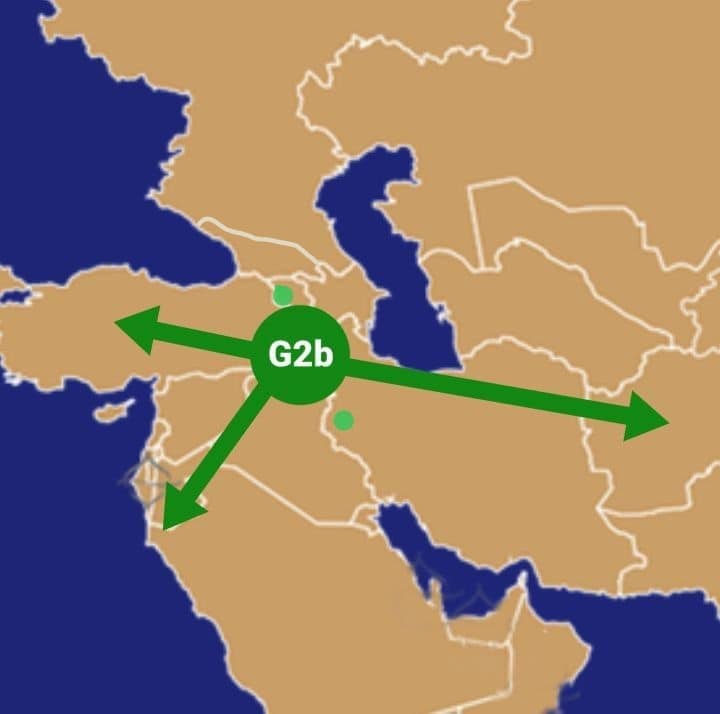
The genetic story of G2b

Thanks to Hovann Simonian we have a number of modern Armenian G2b on Yfull. Coupled with ancient DNA we can now have a better idea about the history of G2b.

G2b unlike his "brother" G2a was a minor Fertile Crescent lineage that formed in more eastern regions than Anatolia. It was absent in Anatolian and European Neolithic sites. The finding of 9200-year-old G2b in Zagros, West Iran confirms it's more eastern homeland. (See the map). G2b have three important branches, having an old common ancestor, who lived 20.000 years ago. He lived even prior farming was invented. Those three branches had different stories.
  • G2b1-M377 - This branch apparently was a Copper Age lineage. It is popular in Ashkenazi Jews and Pashtos in Afghanistan. Both are result of Current Era founder effects. The common ancestor of Jewish and Pashto clusters lived some 5500 years ago, so it is hard to say its real origin given the absence of aDNA from this branch. An Armenian from Syunik is present on basal position in this branch having a 8700-year-old common ancestor. https://www.yfull.com/tree/G-M377/
  • G2b2a-Z8022 - It was found in Wezmeh cave in West Iran in a Neolithic period. Later another sample was found in Kaps (Shirak) from Kura-Araxes period (more than 5000 years ago). And finally, a number of G2b2a were found from Teishebaini (Karmir Blur) in later LBA and Iron Age period. Etiuni people had preserved some Y DNA from Kura-Araxes culture so the G2b2a was one of them. In most likelihood G2b2a was present in South Caucasus since the Neolithic era. See the second picture. An Armenian from Urfa and a number of Turks are from this branch. Their common ancestor lived 3200 years ago so it's probably represented an old migration of KA to Anatolia and a secondary expansion in Iron Age. https://www.yfull.com/tree/G-Y37100/
  • G2b2b-FT36238 - There are no ancient DNA from this branch. There is a young 2600-year-old branch which apparently is an Armenian branch given the presence of Armenians there. A very distant 19000 years parallel branch is found in Kuwait. https://www.yfull.com/tree/G-FT36238/


Monday, November 20, 2023

Mycenaean Greek Y DNA from continental part of Greece and a Minoan Y DNA from Crete

Mycenaean Greek Y DNA from continental part of Greece and a Minoan Y DNA from Crete. Sources are Lazaridis 2022 and Skourtanioti 2023.

J2b in Mycenaean is from Steppe in most likelihood. It is the J2b2a1-L283 popular in ancient Illyrians.
J2a in Mycenaean is mostly J2-Z6064 a Neolithic era lineage. While the J2a in Minoans has a different composition. Large majority of Minoan Y DNA are new migrants from regions close to Taurus mountains and probably more eastern regions in highlands.

See also


Sunday, July 24, 2022

The genetic history of J2b

In Allentoft 2022 a new Caucasian hunter gatherer (CHG) sample (NEO283) was published. It was similar to two other previous ones but had the Y DNA J2b.

It's age 9700 years old is comparable to the previous oldest J2b from Zagros Neolithic in Iran. Given that the age of J2b is 15800 years we can assume that the homeland of J2b was somewhere between Caucasian range and Central Zagros of Iran. Later distribution of its subbranches support that idea.
  • J2b1-M205 was found in Bronze Age Levant. Given that it appears there in relatively large number with the J1-P58 we can assume that both haplotypes expanded with early Semitic tribes in Bronze Age.  The age of main cluster (~5300 years) supports that theory. The ultimate origin of J2b1 was obviously in more northern regions. Toward the north Zagros and eastern Taurus mountains region. Grugni has found that ~6% of Tehran Armenians had J2b1. Nakhichevan Armenians also seems to have slightly higher level of this branch. It was also noticed in Khatri merchant caste in India. J2b1-B248 was found in Iron Age Armenia (Syunik, Harjis). This branch is found in modern Armenians also.
  • J2b2b-Z2453 This branch was found in Mentesh-tepe in Neolithic Azerbaijan and Hajji Firuz in northwest Iran in Chalcolithic period. Lazaridis 2024 has found a J2b2b in Eneolithic Moldova. Given that this haplotype was absent in Neolithic Anatolia and Europe it is safe to assume that it moved to East Europe via the Caucasian range.  It is found in modern Armenians in small number. 
  • J2b2a1-L283. This is the most puzzling subbranch of J2b. It is frequent in Balkans in Europe. But occasionally can be found in West Asia also. It was found in LBA/EIA Armenia (Norabak). Based on current data this branch moved from South Caucasus to Pontic-Caspian steppe and expanded there with Yamnaya. The age of the is 5500 years and supports its Bronze Age expansion.  In Lazaridis 2024 a J2b2a-L283 was found in Moldovan Yamnaya.  It's an IE marker that was very popular in ancient Illyrians and also in modern Albanians. It is seldom found in modern Armenia.
  • J2b2a2-Z2432 It's the sister branch of L283 but has completely different distribution. It is present mostly in India. In ancient DNA it was found in BMAC and Iron Age Pakistan. Based on its age (9700 years) it must be a Neolithic/Chalcolithic lineage that moved from North Iran to East.
The first picture is the J2b2a while the second one is the J2b1. In total J2b makes ~2% of modern Armenian gene pool.

Updated: 2024 August.

See also 

Tuesday, October 27, 2020

The history of J2-L25

J2-L25 is the second most frequent type of J2 in Armenia (~5%). It is found in Central Asia, from Iran to Europe, in North Africa and Mesopotamia. It is rare in Caucasus. The age of L25 is 9100 year old. It seems all modern L25 descend from one Neolithic farmer who lived in northwestern Iran, southeastern parts of historic Armenia and in north Mesopotamia. The oldest L25 we have is from Tepe Hissar (5500 year ago) in north Iran. L25 was prominent among Iran related farmers but was completely absent among Anatolian and Levantine related farmers.
L25 has three important subclades. Let's see their histories.

  • PF4888, L243 A low frequence branch found in Near East and Europe. One ancient sample was found from Roman era Boghazkoy in Anatolia.
  • F3133 This is the biggest subclade of L25. It migrated to east from NW Iran. It was found in ancient South Central Asia. In Bronze Age BMAC culture. It was also found in east Iran, Jiroft culture. In most likelihood it was present in Harappa also but still no direct prove of that. F3133 has good presence in Iraq. Based on that it was suggested that it can be a Sumerian marker, but still no hard evidence of that. After the arrival of Steppe people in Central Asia (Andronovo) the Proto Iranian community formed as a mixture of Andronovo and BMAC which resulted in the integration of some F3133 in Proto Iranian community. Indeed few cases of F3133 were found among ancient Scythians, Saka and Turkic samples. But most of Armenian cases of F3133 do not belong to this Scythian branch and their presence in Armenia is almost certainly old.
  • Z438, Z387, L70 This branch has a very unique history. It is mostly European and eastern Mediterranean. This is not the result of farmer's migration. Rather a Late Bronze Age migration from Anatolia to Italy and subsequent expansion with Roman Empire. How Z438 appeared in Anatolia is not clear yet. It could have migrated from North Iraq/South Armenian Highland to Anatolia in Late Chalcolithic. The age of L70 subclade is 3800 but the star cluster starts at 3400 years ago which can be linked with Late Bronze Age collapse in Near East and migrations of various Sea People. A paper from ancient Rome has found a signal of migration from Anatolia (ancient Armenian samples were used as proxy) in Iron Age during the Early Republican era. But L70 was not present in few ancient DNA published in this paper, while some L70 were present in Imperial Rome period. Despite a migration to Italy the story of L70 almost certainly is not related to the origins of Etruscans. In Lazaridis 2022 significant number of L70 and samples from parallel branches were found from Anatolia.  The Y17949 parallel to L70 is unrelated to Sea People story.

The history of J2-M67.

M67 is the most popular type of J2 among Armenians so lets understand it's origin.

M67 is 12.000-year-old and has three different subclades each of them has a different distribution.

1/ Y4036 and Z467 is a large, diffused branch found in Europe and West Asia. It rare in Caucasus. It is particularly frequent among Armenians also. It was found in many sites of Bronze Age Anatolia, some of them in possible Hittite layers. Genome wide they were shifted to East. It was also found in Italian Neolithic which is very surprising because in the rest of Neolithic Europe it was absent. This probably means different origin of Cardial ware Italian Neolithic. In ancient Armenia it was found from Beniamin.

2.a/ Z500>M92 This is the most frequent type of M67 among Armenians. It is not frequent among Caucasians. Except in Pontic region and parts of southwestern Georgia. We have few aDNA with M92 but judging its structure and age it's expected to be a Kur-Araxian marker. The presence of M92 in Kura-Araxes site in eastern Georgia (Doghlauri) support this theory. It was found in Bronze Age Levant and medieval Sudan.  In ancient Armenia we have M92 from a site near the village Shnogh (Lori).

2.b/ Z500>Y6240   This branch was found in Bronze Age Crete. In Arslan Tepe and Alalakh. Another young Iron Age branch (Z28602, 2800-year-old) is found predominantly in eastern Pontic region in Hamshen Armenians. 

3.a/ Z7671>CTS900 Is found predominantly among Caucasian people. Reaching the highest levels in the world among Nakh people (the Y3640). This peak is a result of young founder effect related to the breakup of proto Nakh community. It was found in Eneolithic Meshoko-Darkveti culture in Maykop culture which succeeded it. It migrated there from south which is confirmed by their autosomes. It was also found in LBA Hungary. Most probably it reached there via Steppe. This branch is present in Armenia with its own subclades.

3.b/ Z7671>V2639 This subbranch was found in Bronze Age Crete. It is also present in Nakh people which speaks in favor of its Chaff faced ware origin.

Conclusion. The M67 homeland was in historic Armenia. More precisely in its western / northwestern part. Z467 migrated to West. CTS900 migrated to North, the M92 expanded in Bronze Age most probably with Kura-Araxes culture.

See also