Category

Showing posts with label Archaeology. Show all posts

Monday, June 3, 2024

Two different stories in Anatolia

After the Neolithic period migrations from east changed the genetic landscape of plain Anatolia. Those migrations were not an one time event but two major events dated to different periods. It must be noted that in the current state of archaeologic knowledge there are no Neolithic sites in northern Anatolia. Food producing appear there in the Chalcolithic period which starts after the 5800 BCE. See the dividing line on the map.

Currently we have two Early Chalcolithic samples from Hattusa (Buyukkaya) in the north and Tell Kurdu in the south (the green circles on the map). They are dated to the same period after the 5800 BCE yet they have different shifts to east. The northern sample has a strong shift to east close to the Late Chalcolithic samples from the same place (Camlibel Tarlasi). While the southern site (Tell Kurdu) has a very little shift. In my previous thread dedicated to Aintab history I showed that in southern Anatolia the main migration from the east occurred at Late Chalcolithic, thus more than 1500 years later than in the north. Given that that those two events have a different archaeologic background then it's safe to assume that they are related to different ethnic groups.
Based on the currently available data we can link the Late Chalcolithic migrations in the south to the Minoans and IE Anatolians. While the northern Early Chalcolithic migration can be associated with Hattic people. This theory is supported by the strong presence of G2-M406 in Hattusan sites. While the same M406 was absent or rare in the Crete and Minoan civilization sites.
It's worth to note that in western Caucasus and Georgia the Neolithic settlements appear roughly in the same period. We can assume that the same impulse that introduced the food producing to north Anatolia moved also to western Georgia were a peculiar Neolithic culture emerged, different from the Shulaveri-Aratashen related sites in Kur-Araxian basin. Later those western Georgian farmers moved to north triggering the emergence of mountainous pastoralist culture known as Darkveti-Meshoko (after 4500BCE). We have samples from this latter culture. They are from a subbranch of J2-M67>CTS900. What linguistic group is related to the introduction of food producing to the west Caucasus is a more complex subject, which will be discussed later


Tuesday, May 28, 2024

Lernagog 1 - a new Neolithic site in Republic of Armenia near Talin.

New details are emerging about the Lernagog 1 site which was discovered in 2017 by an Armeno-Japanese team. Radiocarbon dates show that it is the oldest Neolithic site in South Caucasus and can be qualified as Early or Middle Neolithic (8-7th millennium BCE) Until the discovery of this site the advent of food producing in South Caucasus was mostly dated after 6200 BCE, known as Shulaveri- Aratashen- Shomutepe culture.

Tthe youngest hunter-gatherer date obtained in foragers cave (Kmlo 2) was 7400 BCE in Armenia. Thus, there was a hiatus of more than 1000 years between the end of the last forager and the start of farming and pastoralism. The Lernagog 1 site fills this hiatus. Research shows that they were making clay houses and were mostly pastoralists. No human bone is found yet
There are two possibilities. One is that Lernagog were local hunters who learned the pastoralism. If so, they would be closer to Aknashen sample. Another possibility is that they were migrants from Fertile Crescent "core area" (see the map). This latter scenario would mean that they were closer to Masis blur sample we have.


Monday, April 1, 2024

Remarks on the Van Urmia ware culture. VUC (2200-1400/1300BC)

Previously I already had a review on VUC. Here I will add some remarks on the frequently asked questions.

+ VUC is a sister culture of Trialeti-Vanadzor culture, it does not descend from it. Both descend from the same parent culture, but despite this they have differences. VUC had painted pottery, while TVC had a different pottery. The grave was directed north-south in VUC while TVC had a east-west orientation. And most importantly TVC were practicing cremation while VUC not.
+ How exactly migrated Proto VUC people is not clear. One option is via Araratian plain but the presence in Aji Chay river basin, toward the Ardabil region suggests that they could have entered from the Mughan region toward the sources of Aji Chay then moved downstream toward the Urmia basin, and then to Van.
+ Karmir-berd culture descend from VUC. We don't have samples from this culture. The Dzori geghi outlier can be related to it. The J2-YP879 from Keti LBA can be another descendant of Karmir berd culture.

+ Unlike the TVC the VUC do not have an evident progeniture. Over time new people settled in Urmia basin from north Mesopotamia and Central Iran cropping the territory of VUC people. You can witness this change with the genetics. Hasanlu MBA (a hypothetical VUC sample) is close to Assyrian - Armenians while the Hasanlu IA is close the Kurds. In most likelihood the regions that best preserved the VUC ancestry are in the eastern Van and northern and western Urmia. South and east of lake Urmia had too much genetic shift. This means that most plausible descendants of VUC culture should be searched in those regions.
+ During Iron Age in forementioned regions we have Biai people from which the Biainili term is derived. We have Armarili (another name Aramali ) supposedly near modern Salmas. According to Sargon the ruling dinasty of Urartu was from Armarili. We have Ayadi near modern Urmia city and Uayis with disputed location. It is quite possible that this Uayis is another name for Biai, which was pronounced as Væy - Vay. According to Petrosyan later terms like Vayoc' dzor are related to this Vay people name. A term that he links with Hittites though.
+ Based on this logic the Manna country doesn't seem to be a good candidate for being a direct descendant from VUC. It has too much Dinkha tepe 2 type ancestry related to Grey ware. Nevertheless, the Hasanlu IA had too much of R1b to be completely unrelated to VUC. One possibility is that some R1b moved further south and east and became part of Grey ware. And reexpanded later with them. This would explain high level of R1b in some Iranian populations like Lurs. Another reason is that some of Hasanlu samples are different genome wide. They are closer to older VUC profile and plot close to Armenians and Assyrians. You can see an example in the fifth chart. Overall, it seems that the Manna country had a multi-ethnic composition and more ancient DNA is needed from south of Urmia to understand better it's structure


Wednesday, March 13, 2024

The origins of Grey ware culture in Iran

We have a decent number of ancient DNA from Urmia basin. Based on that we can say that the Urmia basin was a dynamic place. One of interesting findings is the increase of Iran/Zagros Neolithic ancestry in LBA period. (after the 1600bc). This increase started probably at the end of MBA.

The best archaeologic event that matches this genetic shift is the spread of Grey ware. Initially Grey ware was considered as an Iron Age pottery, but new studies of Iranian archaeologists propose a Bronze Age spread of this pottery which is found in many sites in North Iran (see the map, Fahimi 2019)
Apparently, the current genetic data supports their theory. The origins of this pottery were debated. Northeastern Iranian origin was proposed, but a North Central Iranian origin is also possible. The closest populations to Dinkha tepe 2 are Lors and Mazandarani. If this has any predictive value, then a Central Iranian origin seems more plausible.
In any case the current genetic data supports a more eastern origin of this pottery than the lake Urmia.
As for the ethnicities related to this pottery, the best candidate are the Kassites. Kassite's language remains unclassified. But it seems that they had an Aryan adstrat which is quite plausible given that Mitanni Aryans appear roughly the same period. They were also horse worshippers which also was in most likelihood an Aryan influence.
It is quite possible that Mitanni Aryans were also making the Grey ware before they moved to Syria. Where different potteries were produced by locals.

See also


Monday, February 26, 2024

Here is an excerpt from the Petrosyan 2023 paper about the origins of Kura-Araxes culture. We wrote.

 Here is an excerpt from the Petrosyan 2023 paper about the origins of Kura-Araxes culture. We wrote.

""The increase in the genes of Caucasian hunter-gatherers may be explained this way: the creators of the Kura-Araxes culture did not originate exclusively from the previous Neolithic farmers but was a mixture of farmers living in the lowlands and Caucasian hunter-gatherers related population preserved in the mountains. This also explains their tendency to build settlements in high mountainous areas.""
Like in Europe where local WHG lineages resurged in Late Neolithic, it is possible to imagine that a similar process occurred in South Caucasus. The Kura-Araxes is not a result of new migration from north or south but rather a resurgence of local hunter gatherers who learned pastoralism. Those hunter gatherers could have survived in high alpine regions and forests.
What was the genetic profile of those hunters is hard to say but it is quite possible there were not identic to CHG from West Caucasus and had a profile closer to Aknashen sample. J1-Z1828 can be the lineage of this hunters who shifted to pastoralism. Another important thing to keep in mind is that not all KA samples have high Caucasian ancestry. Some of them like Karnut outlier is more farmer shifted.
More ancient DNA is needed for better understanding this question, especially from Sioni culture which can be the earliest form of this resurgence.

See also

Friday, January 12, 2024

Koban culture 1200-400BC

This data was already published in a Russian paper, now it is corrected and translated in English.

Judging by their autosomes the Koban people were migrants from south. In most likelihood from western parts of southern Caucasus. Their Y DNA G2a1 also supports that idea. Other Y DNA found there is the R1b almost certainly a remnant from earlier periods.
Koban culture also had steppe rich people. One of them was from north Balkans. The authors think that it was a Scythian, but I have a feeling that with more sampling we will find other possible candidates. In any case sometimes after 600BC the area was gradually conquered by Scythians and few centuries later by Sarmatians and a new Iranic people formed there. The Alans.

Klin-Yar III:ID355 Lib2al Female 0.286153
Zayukovo-3:ID72 Lib7al Male 0.042127 G2a1a1a1b1
Zayukovo-3:ID79/1 Lib8al Male 0.449777
Zayukovo-3:ID80 Lib9al Male 0.016644 G2a1a1a
Zayukovo-3:ID82/1 Lib11al Male 0.017636 R1b1a1b
Bratskiye 1-ye Kurgany:ID1402 Lib40al Female 0.338059


Saturday, January 6, 2024

Chalcolithic period cultures.

Chaff faced ware (4300-3500bc) was stretched from Cilicia to Caspian Sea. This cultural horizon is the common denominator of Minoan Y DNA and Maykop Y DNA. Their common ancestor.

One group moved to north from South Caucasus where a variant of this culture is known as Leila Tepe. In the north they participated to the formation of Maykop culture. While another group moved to Crete and Greek islands..From Aintab-Urfa region. It's also possible that CFW related groups moved to Central Asia.
This is the reason why we have similar haplotypes in both places. T1a3 and L2 both in Maykop and Greece. With more sampling from Maykop we will find more common haplotypes.
We have some aDNA from CFW period. It's Areni from Armenia and Azerbaijan LC. Both can be used for the modeling of Maykop in qpadm. See qpadm models in the comments.
As for Sioni-Adablur culture (5300-4300/4000bc) they were a different group who were adding grit to the pottery. We don't have ancient DNA from that period and sites.

The source 1. Sagona A. In: The Archaeology of the Caucasus: From Earliest Settlements to the Iron Age. Cambridge World Archaeology. Cambridge University Press; 2017:v-v.


Thursday, May 4, 2023

A cuneiform inscription on a artefact from Kapan museum in Syunik.

 A cuneiform inscription on a artefact from Kapan museum in Syunik. Left by the king Argishti. This would be the most southern inscription found in the territory of modern RoA


Tuesday, March 28, 2023

Areni and Maykop

The recent French team's paper had some comments about Areni cave which needs clarification.

Areni cave people do NOT descend from Maykop for the simple reason that they are much older than Maykop culture. Areni is from Late Chalcolithic period which starts at 4300bc while Maykop culture starts _after_ 4000bc. On the contrary. Today most archaeologists are inclined to believe that Leyla tepe culture (starts at 4300bc) played an important role in the formation of Maykop. Leyla tepe people ( who by the way had similar pottery as in Areni) from modern Azerbaijan crossed the Caucasian range moved to Daghestan and from there moved to North West Caucasus. Where they meet already preexisting pastoralistic groups that had the J2-M67. They mixed with them and created the Maykop culture as we know.
Paleogenetic data confirms this. Maykop Y dna is related both to older layers (J2-M67) and to new migrants from Leyla-tepe (L2, T1a3). Notice both L2 and T1a3 are found in ancient North Iran also which further reinforce the idea that they moved to north from/via modern Azerbaijan.
Areni cave also had the Y dna L1a which is also connected to North West Iran.
Any similarities of cultures between Areni and Maykop are easily explained by a migration from South Caucasus to North West Caucasus around 4000bc and not the inverse.
But this is not the whole story. When Leyla tepe groups crossed the Caucasian range they almost certainly encountered people of Steppic origin in Daghestan. We have ancient DNA from those old Steppe groups and they are from Progress site. Leyla-tepe-Areni related people in most likelihood mixed with this Steppic groups that is why we see their genetic impact in Areni. As You can see on the attached table Areni people had substantial ancestry from Progress which is in North Caucasus. But this ancestry is mostly via maternal lines. Because the paternal L1a has a local origin.
The reason why Areni women face reconstructions are so unusual is due to this Progress related genes. On the same table You can see that Areni people do NOT have any ancestry from the so called Steppe Maykop which by the way had Siberian affiliation and Y dna Q1. Keep in mind that Progress had Y dna R1b-V1636 and not Q1.
They are many other arguments why Areni is of local origin. Their pottery which is called Chaff faced ware. As You can see Chaff faced pottery became very popular from Cilicia ( Amuq ) to Caspian sea shores in Late Chalcolithic. Those people also had unusual burial practices in jars. Before the LC period grit a type of hard stone was added to pottery. While in LC it changed to straw. With high certitude we can say that the wine making technology as ancients knew was invented in Areni and related to them Chaff faced ware people.
It's possible that during this interactions between South Caucasus and Steppic Daghestan some Y dna also appeared in South Caucasus. The best candidate would be obviously the V1636. But we don't have any direct proof of that. What is needed is to have more ancient DNA from Late Chalcolithic period ( 4300-3600 bc ) in South Caucasus. French team tried to extract from Mentesh tepe but they failed due to extremely low coverage. So, we wait for the next attempt.


Friday, March 3, 2023

During the construction of a mall in southern parts of Yerevan an Urartian stone tomb was found with multiple burial urns and other artefacts

 During the construction of a mall in southern parts of Yerevan an Urartian stone tomb was found with multiple burial urns and other artefacts. Currently the tomb is accessible to visitors.

One remarkable finding is an inscription in unknown script and language. Earlier in this group I mentioned that in some Lchashen cyclopean forts short inscriptions were found in Sovietic period. Those inscriptions are considered as fake by some scholars. But this finding shows that there was a real diversity of scripts in Iron Age Armenia. Another type is the ieroglyphic script.
This particular inscription is too short to make a judgement. But if new similar inscriptions are found then we can better understand those unknown inscriptions.

Thursday, March 2, 2023

A group of Armenian and Polish archaeologists has found a rich burial of a couple in Metsamor

 A group of Armenian and Polish archaeologists has found a rich burial of a couple in Metsamor. Most probably spouses. The date is around 3200 years before present. So it's Lchashen culture period. Crosses similar to Celtic style are remarkable.

Metsamor was an important fortified city in Early Iron Age. With advanced metallurgic and jewelry industry. You can see similar artefacts from previous excavations in the link below. They are exposed in Metsamor museum.

Thursday, February 2, 2023

The Van-Urmia ware (or Urmia ware) culture.

 The Van-Urmia ware (or Urmia ware) culture. Other names used in post Sovietic countries are Karmir Vank or Kyzil Vank culture. This name is derived from a site in Nakhichevan.

This pottery appeared in Middle Bronze Age after the Kura-Araxes culture. Probably after the 2200/2000BC and ends around 1400/1200BC. It was initially related to the developments in South Caucasus MBA cultures like Trialeti Vanadzor but later evolved on it's own.
The main information about this culture comes from North West Iran. Haftavan tepe and Geoy tepe. Unfortunately despite the large number of ancient DNA from that region we don't have any sample that can be securely linked to Urmia ware tradition.
The reason for this is that in Middle and Late Bronze Age period there were other potteries circulating in Urmia basin. One of them from Dinkha tepe is related to Khabur ware. A type of pottery prominent in North Mesopotamia. Ancient DNA confirmed it's link with Mesopotamia. (See links in comments).
This means that the map attached shouldn't be taken at face value. The situation both in TVC and Van-Urmia lands was more complicated than it is painted.
Nevertheless despite the absence of any ancient DNA we can make some deductions with indirect methods.
As I previously noted the TVC>Lchashen group practically didn't have any R1b-Y4364. Only one case was found in Karashamb while the absolute majority was R1b-L584.
But modern Armenians do have both Y4364 and L584 which means that this branch was "hiding" in a different culture and place.
The best candidate for harbouring Y4364 is the Van-Urmia culture. There are some lines of evidences for this. First R1b-Y4364 was found in Iron Age period in North West Iran. Modern distribution also favours more southern distribution of Y4364. It's age also fits to that period. Van-Urmia folk also migrated to west.
But this R1b branch is not the only haplotype that can be linked to Van Urmia ware. The other one is the J2a-YP879. It's age and specific distribution in Armenians do favour the idea that it formed in Middle Bronze Age Van basin and expanded from there. Indeed it was found in Iron Age Urartian period.
With time we will learn more about other haplotypes also. Now the most interesting thing is that despite having common origins TVC and Van-Urmia were not interested to have contacts with each other. No single case of I2c2 was found in NW Iran despite the fact that it was prominent in TVC lands. This is a strong indication that TVC/Lchashen group and Van-Urmia had different identities.
Here is a list of various possibilities.
1. Van-Urmia was proto-Urartian. Not in a sense of kingdom but as ancestral to Urartian language speakers.
2. Van-Urmia was an IE culture which was speaking a sister language related to Lchashen/Etiuni. In this scenario proto Urartian would be an offshoot of Khabur ware that moved to North.
3. Other possibilities are more complicated scenarios. Like mix of Hurro-Urartian and IE with possible influences from other neighbouring languages. The presence of terms starting with R, like city Riyar or land Ruisa with his king Rasu indicates a presence of non-HU, non-Hittite and non-Armenic groups in the Van basin.
Over time with more samples we will learn more about Van-Urmia culture and it's descendants in Iron Age. It's quite possible that Mannaeans are also descending ultimately from this culture.
* The map is from Raffaelel Biscione's "The Roots of the Urartian Kingdom"

See also...

Sunday, December 11, 2022

New ancient DNA from Georgia and Azerbaijan helps to refine our understanding of ancient populations distribution and boundaries.

New ancient DNA from Georgia and Azerbaijan (Koptekin 2 022) helps to refine our understanding of ancient populations distribution and boundaries.

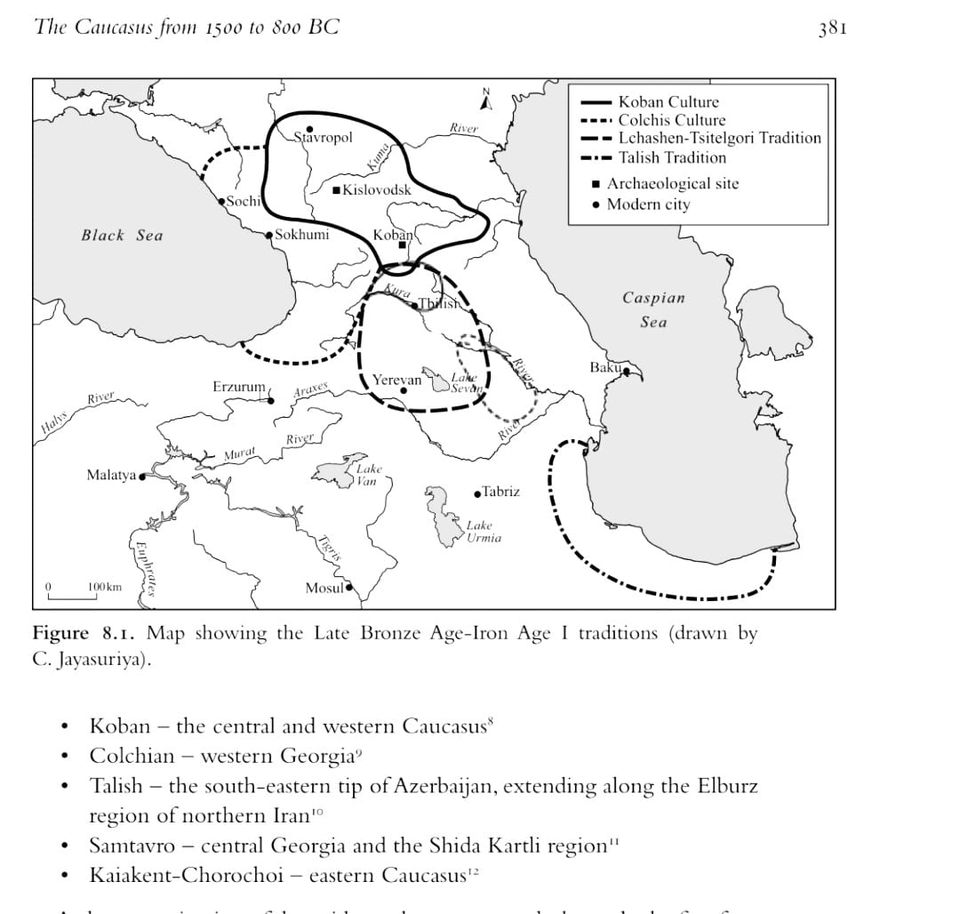
The map below shows the distribution of LBA and IA period cultures around Caucasus. We have enough ancient DNA from Lchashen-Metsamor culture in Republic of Armenia to compare them with other sites.

In Georgian literature this culture is known as Lchashen-Tsitelgori and as You can see on the map it is stretched quite north reaching Greater Caucasus range. But it was obvious from the start that not all sites labeled as Lchashen-Tsitelgori will yield the same genetic profile as in Republic of Armenia.
Some Georgian archaeologists defined another name for this period calling it Samtavro culture. It seems this was a correct path because it's now evident that Lchashen-Tsitelgori generic name hides two distinct populations. An LBA sample from Doghlauri site (known as Lchashen-Tsitelgori site) in Central Eastern Georgia near Kur river do not have steppe ancestry and is more western shifted compared to the Kur-Araxian period sample from the same site. The Kura-Araxes sample from Doghlauri is J2-M92.

While most samples from Republic of Armenia  Lchashen-Metsamor related sites do have steppe ancestry. Without much doubt they were speaking an IE language affiliated to Armenian while the other population in Georgia which has no steppe ancestry is in most likelihood related to  Samtavro horizon.
 
What language was speaking those Samtavro people is hard to say. Either a Kartvelian in this case it would be proto-Georgian or proto-Iberian. Either a language that descend directly from Kur-Araxian culture. But this latter is unlikely.

We have also samples from Kakhetia in Eastern Georgia close to Alazani - Kur river junction from sites Didnauri and Nazarlebi. They are very similar to those samples we have from Lchashen-Metsamor culture and they have R1b and possibly I2. Based on that we can deduce that the Khojaly Gadabay culture which was present in historic Utik' and Artsakh provinces might be related to Lchashen culture also. Moreover, the structure of I2 permits to say that Lchashen culture expanded from modern Republic of Armenia to east playing a role in the formation of Khojaly Gadabay culture. This is consistent what Laneri 2020 was thinking about that culture. What language was speaking this Khojaly-Gadabay culture is hard to say.

Finally, we come to Caucasian Albania puzzle. A sample from Iron Age Shamakhi in Azerbaijan is ideal to have a clue about Albanians (Aluank'). This sample do have steppe ancestry like most representatives of Dagestani family. But it is shifted to Caucasian foragers (east). More important its Y DNA is J1-Z1842 which is the predominant haplogroup in Dagestani speakers. This is extra evidence that Nakh-Daghestani people descend from Kur-Araxian culture. Keeping in mind that we speak here only about the northeastern parts of Kur-Araxian Culture and not the whole horizon.

Where exactly formed the Lezgic group prominent in Albania is hard to say. If we follow Nichols classification, then Lezgic group might have initially formed in the north in Dagestan and later moved back to southern slopes of Greater Caucasus. If we follow Schulze's linguistic classification which consider Lezgic an early split, then it could have formed in situ directly from Kur-Araxian culture in southern slopes which were not affected by steppic Kurganic cultures. More data will clarify this, but I am inclined to believe that they came from mountainous Dagestan in north otherwise Lezgic group people including the Udi wouldn't have such a high level of Steppe ancestry.

And finally, I want to say few words about the possibility that Lchashen (Etiuni) had a Lezgic speakers. Well from dozens and dozens Y DNA we have from Lchashen only 1 is J1-Z1842! This outcome does not leave any place for any speculation about the identity of Etiuni. They were IE without doubt. Lezgic speakers should be searched in cultures like Kaiakent-Chorochoi and Yaloilutepe in northern parts of Azerbaijan.


Saturday, September 3, 2022

The missing piece from R1b puzzle. The R1b-Y4364

 The missing piece from R1b puzzle. The R1b-Y4364

With a unprecedented number of Y dna we now have better understanding of ancient migrations of known haplotypes At last two haplotypes appeared after the 2500bc. The R1b-Z2103 and I2a2b ( old name I2c2 ) The Z2103 has a complex structure. Let's see each branch separately.
+ L584 the most frequent type of Z2103 in Armenia. More than 50% of Z2103. It was popular in Lchashen culture (Etiuni land) and almost certainly was there since Trialeti Vanadzor period. It was also present in Hasanlu IA.
+ Y4364 it is the second by frequency in Armenia. But for some strange reasons it was absent in Lchashen-Metsamor culture. Two cases were found in Hasanlu IA which genome wide shows connections to western Vannic/Zagros regions.
+ Z2106>CTS8966 is the third by frequency. It has a moderate low presence today. It was found in Lchashen. Given it's modern distribution it could be more frequent in Sevan-Uzerlik (Artsakh ) culture. But we don't have any Y dna from this variant of MBA cultures.
Then we have PH331 and Z2110 subclades. It seems PH331 was present in Lchashen but I didn't noticed Z2110 yet. Both branches have low frequency today.
This absence of Y4364 is puzzling. In most likelihood it has a different story from L584. Two scenarios are possible.
+ Y4364 moved from modern Armenia to west toward Erzrum region were it evolved for sometime in Hayasa region. Later it expanded with Mushki and Urumu in Iron Age. It moved to Hasanlu in Iron Age via Van/Vaspurakan.
+ The second scenario is that it is related to Van-Urmia pottery. It moved to Urmia then to Van. It's presence in Hasanlu is old since MBA. It will have presence in Vannic Urartians also. In this scenario the Mushki Urumu can be related to the PH4150 subclade of L584.
In sum Y dna from Turkey is needed to better understand the story of Y4364 and it's potential ethnic affiliations. Right now we can we say that it was present in ancient Mannaeans.


Sunday, July 3, 2022

The black burnished Etiuni pottery before the Urartian arrival. Also known as Lchashen-Metsamor culture.

   1.The black burnished Etiuni pottery before the Urartian arrival. Also known as Lchashen-Metsamor culture.

2. The red Urartian pottery, that appear in modern Armenia in 8th century BC. But remain unmixed till 7th century.

3. The syncretic "local Urartian pottery" also known as Lchashen-Metsamor VI period. This third syncretic type forms in 7th century BC. The remarkable thing is that it contains also Scythian arrowheads in burials. Which btw do not mean automatically Scythian person. This third type persist well into Armenian Satrapy (6th-5th century BC) period which is marked by the arrival of Achaemenid Persian political and cultural influences. New type of potteries included.


Wednesday, September 1, 2021

Population dynamics in North Caucasus

Population dynamics in North Caucasus.

From already published papers we know that North Caucasus had two distinct populations that most of the time had little interaction with each other.  

One was in plain/steppe parts of North Caucasus (here after NC). This Steppe NC was connected to Eurasian plains in the North. The second population was living on the Northern slopes of Greater Caucasian range. It had South Caucasian origin and they settled there mostly after the Eneolithic. (after 4500bc). Currently there is no evidence that those northern slopes were inhabited in Mesolithic and even in Neolithic.

This dichotomy was so pronounced that it was present in Maykop culture which was an unified culture between Steppe and Mountainous NC, but still inhabited by two distinct populations. The Steppe Maykop (Q,R1) which was of Siberian origin and Mountainous Maykop related to Leyla-tepe (L, T, G2, J2b2a?).


When Yamna formed (3300bc) and started to expand, it moved to South also and conquered the lands of Steppe Maykop practically replacing them without mixing. There a new culture formed which usually is labeled North Caucasian culture ( first map the blue culture ) but a less confusing name is the Kubano-Tersk. We have ancient DNA from Kubano-Tersk people and they were predominantly R1b-Z2103. Genome wide ( autosomes ) they were identic to Yamna.


After 2800bc Yamna transformed into Catacomb culture with the same Y DNA. Catacomb culture had a strong influence on Kubano-Tersk which is not surprising because they were kinsmen. It basically absorbed it. Was this absorption due to cultural influence or there was another migration is not clear.

You can see that on the second map. Then one group of unknown part of Catacomb culture moved to South Caucasus via Daghestan no later than 2400bc. We discussed a lot this event. 

Hrach Martirosyan once expressed an opinion that Armenian do show evidence of archaic contacts with Abkhaz-Adyghean languages who are usually associated with Dolmen culture. If that is true then it must have occured during that Catacomb period or slightly later. 

The catacombicized Kubano-Tersk culture continued to evolve and it started to mix with neighbouring Mountainous NC who where predominantly J and G. This gradual mixing will lead to the formation of Koban culture (1300-400bc)


At 2200bc Catacomb culture ends and two new groups appear in his place. One is called Multi-Cordoned ware (2200-1800bc) which was mostly in Pontic Steppe while the other is labeled Lola. Lola was in the West of Caspian sea. The remarkable thing about Lola is that it was a partial resurrection of old Steppe Maykop people who were of West Siberian origin. We don't have ancient DNA from Multi-Cordoned ware. But in most likelihood it was similar to Catacomb with some possible influences from Carpathian mountains. There are some serious reasons to believe that Multi-Cordoned ware was speaking some kind of Balkanic languages. Some even proposed a link with Mycenaeans but with current data it's unlikely. For us it can represent interest if we learn that the I2c2 in Armenia and E-V13 in North Caucasus are related to this culture activities.


(to be continued...)


We use frequently this terms. So such a table is needed.

 We use frequently this terms. So such a table is needed.

The archaeologic periodization of modern Republic of Armenia. Notice other parts of historic Armenia could have slightly different periods. 

The pre-pottery Neolithic is now divided into Mesolithic 10000-7500bc and Neolithic 7500-5200bc.

In 2017 a new Neolithic site was found in Armenia dated to 7000bc.

Currently we have ancient DNA from Late Chalcolithic to Early Iron Age. Next year I hope we will see Urartian period DNA.


Thursday, July 1, 2021

Few comments on this maps.

Few comments on this maps. 

The author of this maps Guido Garducci has no single peer reviewed paper. More ever I couldn't find any paper authored by him the last time I checked this subject.

So most of his claims should be taken with caution.

Nevertheless he decided to write a book on Iron Age pottery in historic Armenia. And proposed a name Nairi ware.

What he calls "Nairi ware" is usually labeled "grooved ware" in academic papers. 

The grooved ware spread all over historic Armenia immediately after the late Bronze Collapse in 1200 bc. In many places grooved ware people created new settlements. 

 Scholars usually place the origin of this type pottery in the East or North of historic Armenia, were more older specimens of grooved ware are found.


Veli Sevin linked it with Mushki specifically mentioning that it was an IE tribe. The timing is very good for Mushki theory. Graducci is also mentioning Mushki in relation to grooved ware.

Despite this Sevin's opinion was criticized for giving exclusivity to IE Mushkis and an alternative theory was proposed that it was Uruatri people pottery. This theory also has good timing but has other problems because Uruatri was initially a small polity. Interestingly the grooved ware was present in Urartu but the distinctive Urartian red elite pottery is not directly related to it. 

And finally it must be noted that Lchashen culture was relying on grooved ware at last since 1500 bc till the arrival of Urartu at 800 bc. Here the link of ethnicity with a pottery is very secure.


 So finally who were those people spreading the groove ware at Early Iron Age (1200bc) all over historic Armenia? 

Almost certainly not the Nairi because the term Nairi is mentioned before the 1200 bc. But offcourse they settled in the lands of Nairi also and became part of it.

In other peripheral regions also the grooved ware people were assimilated by the neighbouring Luwian , Semitic cultures.