Saturday, March 12, 2022

When Xenophon reaches Pontic region there he mentions Drilae.

 When Xenophon reaches Pontic region there he mentions Drilae. A small tribe dwelling near Trabzon. Not much is known about this tribe. Later it is mentioned few times as Drillae/Driloi or one time as Dryloi. 

Hewsen tentatively ( with question mark ) link the names of Daranali and Derjan to this Drilae but this is a weak theory. He also see a link with Trel-k' which is much more robust.


Trelk' is the Armenian name of Trialeti ( a region in Georgia ) with the -k' plural suffix. It is quite possible that those Drilae were an offshoot of Trelk' who moved to Pontic region under the pressure of Cimmerians or due other event.


Why I think Cimmerians? Because Strabo mentions numerous times a tribe known as Treres, which was either a Thracian or Cimmerian tribe. He mentions it both in West and East of Black sea. Once more we see mysterious Thracians in or around Armenia. Which means that the term Thracian was used as catch all term for tribes that Greeks had hard time to classify.


It is quite possible that the early form of Drilae/Trel-k' was initially Trer-. Later a shift occured. Pliny's term Triare seems to support this assumption.


Wether those Treres/Treles came in Iron Age or they were present in SW Georgia since Bronze Age is hard to say. But some of them ultimately moved to Pontic region ( with Qulha? ) where they were mentioned by Xenophon.


http://www.perseus.tufts.edu/hopper/text?doc=Perseus:text:1999.01.0202:book=5:chapter=2&highlight=drilae


http://www.perseus.tufts.edu/hopper/text?doc=Perseus:text:1999.04.0064:entry=treres-geo

Frequently I get the same question.

 Frequently I get the same question. Why Assyrians are close to Armenians in various charts. The answer to this question is both simple and complicated.


Simple because Assyrians do have extra non Levantine ancestry which pulls them away from other Levantine people. And make close to Armenians. Which btw is also visible in Y dna structure of Assyrians.


But it's also complicated because one should understand that history of an ethnic group do not stop in Iron Age. So one must learn the whole history how Arameans initially living Syria became modern Assyrians. Morever an ethnic group over time can transform into ethno-religious group which can affect seriously the genetic structure of that population. This part is beyond the scope of this thread. So my point will be genetic.


The first PCA shows the relative position of Assyrians marked as Arameans. Notice if they had simply Armenian admixture they would be between Levant and Armenia. But they have also a shift toward Iranian pops. Which means that they have extra Iranian ancestry or something related to them. In the second PCA it's visible that Georgian Jews also plot in the same place as Assyrians. 


This fits well with the geographic position of Assyrians (NW Iran, North Iraq, East Turkey etc) It must be noted that North Iraq probably had witnessed number of migrations from Iran (Gutians, Carduchoi , Turukeans etc ) So that region almost certainly had an extra Iranian shift before the arrival of real Iranians in Iron Age. As for Jews there are historic records mentioning Adiabene people and even some Iranian nobility converting to Judaism ( like Amatuni ) Good knowledge of history is needed for better understanding this genetic results.


Wednesday, March 9, 2022

Few comments about Y dna and language correlation

 Few comments about Y dna and language correlation. We know that ancient America was populated by a very limited number of Y dna more than 15.000 years ago. Mostly few branches of Q1b. Yet the linguistic diversity of pre Columbian America is huge. Here an excerpt from Wikipedia.


------


Over a thousand indigenous languages are spoken by the Indigenous peoples of the Americas. These languages cannot all be demonstrated to be related to each other and are classified into a hundred or so language families (including a large number of language isolates), as well as a number of extinct languages that are unclassified due to a lack of data.


-----


This diversity is impossible to explain by new migration. Only two new migrations are known to have occured later. One of which introduced Na-Dene languages ( famous Apaches ) with the Y dna C2. While the other introduced Eskimo- Aleut languages with Q1a? branch. Those two migrations occured less than 6000 years ago and some believe that Na-Dene still preserved a connection with a Siberian isolate known as Kets.


What this mean for linguistics and genetics? This mean that linguistic has its inherent limitations. After 10.000 year of separation two related languages accumulate so many random phonetic shifts that it is practically impossible to reconstruct their common vocabulary.

This is especially true if languages are illiterate and do not have developed religions and sacred languages. Are mobile hunters. A similar situation can be expected in Paleolithic West Eurasia. Though higher population density in Near East probably made languages more stable. But in any case even if two languages descend from G2 rich pop then some 15.000-20.000 years later it would be impossible to prove their genetic link.


https://en.m.wikipedia.org/wiki/Indigenous_languages_of_the_Americas

Tuesday, March 1, 2022

Comparison to ancient Arslantepe (Malatya) samples.

 Comparison to ancient Arslantepe (Malatya) samples. The transition from Late Chalcolithic to Early Bronze Age made all that region near upper Euphrates and North Mesopotamia more closer to modern Armenians. Especially the Urfa Armenians. Obviously this is related to Kur-Araxians migrations.

Titris Hoyuk also was affected. But the overall change is not high.


Sunday, February 27, 2022

We have new regional data from Urfa

 We have new regional data from Urfa. Thanks to Sunshine Shoghig Shahinian who provided the files. The data was analyzed by Robert Navoyan and me.


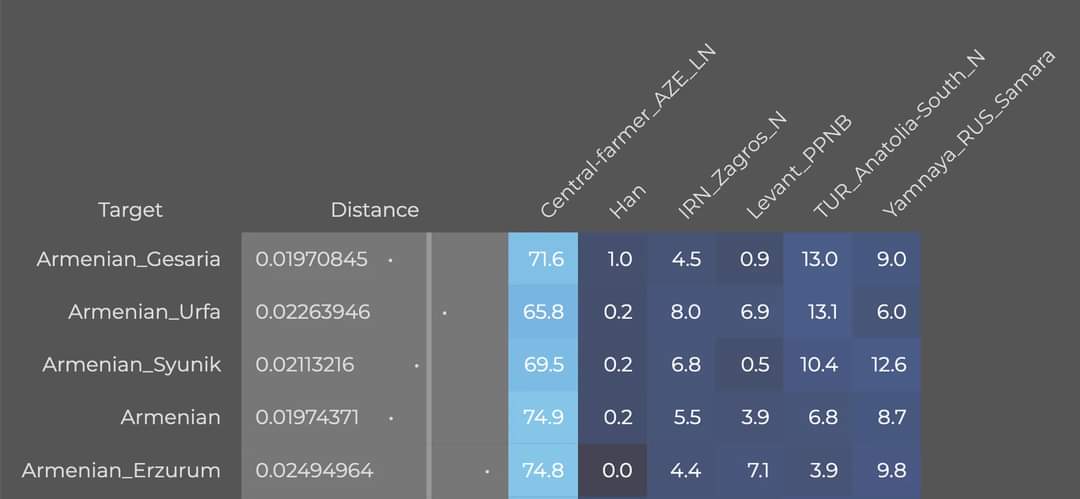
1/ The first chart shows the closest populations to Armenians from Urfa. As expected the Armenian average is one of the closest. But Erzurum is slightly closer.


2/ The ancestry proportions in the second image shows that Urfa Armenians have similar structure compared with other subgroups. The main difference is the slightly higher South Anatolian Neolithic ancestry which is consistent with their geographic position. They have also lower Steppe which makes sense given the distance from Caucasian range. To my surprise they don't have extra Levantine ancestry. Their Levantine ancestry is equal to Erzurum ( from Javakhk ) levels which is quite interesting. Because it can mean that in the past Euphrates was used to move to North from Upper Mesopotamia. It's also consistent with the fact that the kingdom Dayene/Diaukhi in Nairi was initially in the south then moved to North toward Erzurum region. Though this result can be the consequence of earlier or later events.


3/ The third image is a PCA. Consistent with the previous analysis the Armenian_Urfa has a slight shift toward west/Anatolia and partly overlaps with Greek_Cappadocia. Despite similarities with Assyrians in Gedmatch the Urfa Armenians are not pulled toward Assyrians. 


4/ And finally we wanted to compare Urfa Armenians with an ancient DNA from Titris Hoyuk Early Bronze Age. This site is close to Urfa. Well it turns out that the closest modern pop to a local Bronze Age sample are the Urfa Armenians. This is a remarkable finding. It must be noted that this do not mean that no any migration occured since EBA. They almost certainly occured simply those migrants were not very different from Titris Hoyuk.


Also one should not confuse this result with the closest ancient DNA to Urfa Armenians. The closest aDNA to Urfans is still the South Caucasian Neolithic like for all other Armenians. This type of ancestry which we label Central farmers was present all over historic Armenia. And Cayonu008 sample showed that it was present near Urfa also since the Neolithic. But this a subject for different topic.


Distance to: Armenian_Urfa

0.03081703 AZE_Caucasus_lowlands_LN

0.03462119 IND_Roopkund_B_o

0.03468724 TUR_Arslantepe_EBA

0.03706614 IRN_Hajji_Firuz_C

0.03929593 TUR_Arslantepe_LC

0.04178189 TUR_Alalakh_MLBA

0.04550224 TUR_Ikiztepe_LC

0.05022027 SYR_Ebla_EMBA

0.05031025 TUR_Titris_Hoyuk_EBA

0.05114875 TUR_Ovaoren_EBA


PS I want also to thank Tsolig Shahinian for her activism.


Monday, February 14, 2022

Strabo reports that in ancient times there was a large lake ( sea ) in Araratian plain.

 Strabo reports that in ancient times there was a large lake ( sea ) in Araratian plain. It must be added that this is true. But it was in Neolithic times and not in Iron Age. Somehow the memory about this lake was kept. 

Then it disappeared. Maybe due to earthquakes? Who knows.

----


The Araxes also in Armenia, descending from the mountains, is said to have spread itself in ancient times, and to have overflowed the plains, like a sea, having no outlet; that Jason, in imitation of what is to be seen at Tempe, made the opening through which the water at present precipitates itself into the Caspian Sea; that upon this the Araxenian plain, through which the river flows to the cataract, became uncovered. This story which is told of the river Araxes contains some probability; that of Herodotus15 none whatever. For he says that, after flowing out of the country of the Matiani, it is divided into forty rivers, and separates the Scythians from the Bactrians. Callisthenes has followed Herodotus. [14]

http://www.perseus.tufts.edu/hopper/text?doc=Perseus%3Atext%3A1999.01.0239%3Abook%3D11%3Achapter%3D14#note-link15


Tuesday, February 1, 2022

The name Urdi is attested in Urartian cuneiform texts.

 The name Urdi is attested in Urartian cuneiform texts. It matches perfectly to Armenian word ordi (որդի) meaning son, offspring. This is a native Armenian word. Cognate of Greek portis and Sanskrit prthuka.


There was also a noble family Orduni whose name also could have been derived from the same root.


If this Urartian name is really related to the Armenian word this could mean that the p>h shift had already occured in Armenian language before Urartian period.


https://en.m.wiktionary.org/wiki/%CF%80%CF%8C%CF%81%CF%84%CE%B9%CF%82


https://hy.m.wikipedia.org/wiki/%D5%88%D6%80%D5%A4%D5%B8%D6%82%D5%B6%D5%AB%D5%B6%D5%A5%D6%80