Thursday, July 13, 2023

The story of Hurrian thunder god Teshub fighting his father Kumarbi and Greek god Zeus fighting Cronus has many similarities.

 The story of Hurrian thunder god Teshub fighting his father Kumarbi and Greek god Zeus fighting Cronus has many similarities. Those similarities concern specific details which makes unlikely the possibility of random coincidence. Two possibilities can be envisaged for explaining this situation.

- That all similarities are due to Greeks influenced by Hurrian and Near Eastern myths.
- That at last part of similarities are due to IE influence on Hurrians.
In the Wikipedia page about the Teshub we can find the opinion of Beckman on this subject:
-----
According to Gary Beckman these similarities are not a sign that the conflict over kingship in heaven was a narrative of Indo-European origin, but rather instead an indication that it was what he deems a “theological ‘areal feature’” known across Mesopotamia, Anatolia and the Mediterranean.[247]
-----
Beckman do not discuss the possibility that the Hurrian themselves could have been in contact with an IE group and the story of thunder god fighting his father and a monster dragon is an introgression in to Hurrian religion from an IE source in particular the Proto Armenian. But this possibility should be envisaged given the geographic proximity of Hurrian and Armenian homelands.
This possibility is supported by many lines of evidence presented in various papers of Armen Petrosyan.
- The Hurrian snake dragon Ullikumi has an IE etymology. Derived from a reconstructed *wel. The root wel is found in Etiuni and an indirect evidence suggests that prior the term vishap Armenians did have a term wel for the dragon.
- The name of Teshub has no Hurrian etymology. But it has a good etymology in Armenian. From the IE root *teks meaning "to weave," also "to fabricate," especially with an ax. In Armenian t'eshi/t'eshik meaning spindle derives from this root. Both the meaning spindle and ax are attested in Germanic languages derived from this root. In other IE languages the meaning ax is prevalent. Thus Teshub could have mean ax holder/keeper in old Armenian. *teks + *hep > teshub
- Armenian god Vahagn and vishap are loanwords from the Iranian. The thunder god killing a dragon is present virtually in all PIE derived groups. Thus Armenians also should have their own terms. Teshub/Teisheba and Welik attested in Hurro-Urartian texts are good candidates for those terms.
- Teshub initially was not the most important deity in Hurrian gods pantheon. It is first attested at around 2200/2100 bc. But it becomes prominent only in 2-nd millennium BC. So timing do not contradict to this theory.
- Teshub is not the only thunder god having the IE root *teks as a root. In Hayasa there was a thunder god U.taksana were taksan means carpenter in Sanskrit while the U is the ideogram for thunder gods. The apparition of this god in Hayasa pantheon might be related to Mitanni Aryans presence in that region. The reason why Teshub can't have Aryan origin is that phonetic shift corresponds to Armenian. And the timing will not fit.
This were the main arguments. You can read the others in the A. Petrosyan's paper in Russian.

Friday, July 7, 2023

I am preparing a large thread about the post Urartian Armenia (RoA), especially the shift from Etiuni to Armenian genetic profile.

 I am preparing a large thread about the post Urartian Armenia (RoA), especially the shift from Etiuni to Armenian genetic profile. I started to look closer to some relevant samples. For instance the two samples labeled Sarukhan_unknown.

They are supposedly from 72 BC but their autosomes are typically Lchashen Metsamorian (1500-800/600bc). This is the main reason why they are labeled as "unknown". Because their genetic age do not much their supposedly radiocarbon age.
After looking closer I realized that they were not radiocarbon dated. Here what the supplement says about their ages.
"Context: Date(s) from same site (I20437)"
This means that they are dated based on the archaeologic context and the radiocarbon dating of I20437 which is indeed from Artashessid period. Both by genes and radiocarbon.
In most likelihood their true age is LBA/EIA. Their Y DNA is also typical to that period. I2 and E-M84. This means that at this point the last sample after which we don't see anymore the typical Etiuni/Lchashen profile is dated at 603BC. A sample from Karmir Blur. This date correspond to the end of Urartu. Offcourse we have a gap between 600 and 400bc which needs to be filled. We also should keep in mind that radiocarbon dating will never give the necessary precision. But overall we can assume that it's during the end of Urartian kingdom that some important genetic changes occured in RoA.
PS Unfortunately there is also a typographic error with one of Sarukhan unknown samples. The one with id I20444 correspond to P6662 bone, but in the spreadsheet it is erroneously connected to P6644 bone. This is only a typo that do not affect the overall result.


Tuesday, July 4, 2023

Another example when an ancient deity is mentioned in old Armenian texts as a person

 Another example when an ancient deity is mentioned in old Armenian texts as a person.

Urartu had numerous gods. One of them was Quera. The name of this deity is also present in the city name Queraitase. Which is interpreted as a "gift of Quera".
In Hovhan Mamikinyan's texts there is a certain Quar/Kuar who was the son of Demetre and Gisane. He had also two other brothers Meltes and Hore(n). They founded cities in Armenia and gived their names to those cities.
It is remarkable that in India there is a god of wealth Kubera/Kuvera which was compared to this Quera. The Indian god has no reliable etymology. So it can be from pre-Aryan cultures.

Wednesday, June 21, 2023

The Y dna distribution by haplotypes in modern Armenians : dotting the I2-s.

The first chart is based on modern commercial data from FTDNA. It shows the most important branches also known as haplotypes. As You can note, with the exception of R1b-Z2103 the rest of Y dna is quite fragmented. The number of haplotypes that score more than 3% of population is ten. In this list of top 10 the TVC lineage I2-BY423 (also known as Y16419) is in the 9th position. I think based on this chart it's obvious that any Armenian haplotype that score more than 3% can't be labeled as "very low" or "inexistent".

But this is not the whole story. In this top 10 at last 4 haplotypes have a Neolithic - Chalcolithic age ( J2- L25, G2-M406, T-L208, E-M84 ). And current paleogenetic evidence supports their relatively old expansion. Although in some cases they have also younger lineages. Like J2-L25 which has a subbranch L70. It makes the third of L25 and it expanded in Iron Age.
So if we concentrate only on Bronze Age expansions that have more relevance to modern ethnicities then the list will be arranged in a different way.
The main lineage that expanded in Early Bronze Age (Kur-Araxian culture) are the J1-Z1842 and most probably the J2-M92. It's possible that E-M84 also is partly related to KA but there is no direct proof of that theory.
The lineages that expanded in Middle Bronze Age and after are the R1b-Z2103, I2-BY423, J2-FGC15865 ( a lineage related to Van-Urmia culture ) and R1a-Z645 appears predominantly in Iron Age.
There is also a Bronze Agr lineage J1-L862. It's from Levant and Mesopotamia.
They are also lineages that expanded in Iron Age and later but their percentage points do not exceed 1.5-2%. And they are too late to be crucial for the Ethnogenesis. Even though they are important for understanding some aspects of Armenian history.
Returning to I2 in Armenia. The main question is that did it had a dramatic decrease over time given the available paleogenetic evidence?
Well to have an answer to that question one needs to compare apples to apples not to oranges. I mean that modern Armenian Y dna is gathered from a large territory stretching from Cilicia/Sebastia to Caspian Sea/Iran. If we want to understand how the level of I2 changed over time we need to compare data from equal geographic regions.
We don't have detailed Iron Age aDNA from the aforementioned region. But I think it's not hard to imagine that it's very very unlikely that I2 level exceeded 5% in Iron Age historic Armenia and it's large neighbourhoods if a systematic ancient DNA becomes available.
Even more. Inside ancient Republic of Armenia the I2 was present in high levels only in Sevan basin sites. See the second chart (Noratus, Lchashen, Sarukhan ) Karashamb in Kotayk is close to Sevan. If we look at Urartian era samples that do not have any aDNA from Sevan basin then we see a completely different picture. See the third chart. Offcourse 20 Y dna is a small sample size. But we can reproduce a similar result for LBA-EIA period if we remove all Sevan basin sites.
In any case it's obvious that in modern RoA territory there was an important change of Y dna distribution in Iron Age. I will dedicate a special thread to this subject. Obviously both I2 and R1b decreased but given current data we can say that while they decreased in RoA they must have increased in some other regions of historic Armenia. Otherwise how we would have 3% of I2 from large territory stretching from Anatolia to Iran?
In conclusion the current Armenian Y dna is dominated by haplotypes that expanded Bronze Age. Initially they had localized peaks in certain regions. But overtime they diffused out of their peak regions and modern distribution became more homogenous. I2 is not a special case in this story. The only thing that it has more limited geographic peak than R1b which in most likelihood expanded over larger regions.
PS We also should remember that native population of Sevan basin do not live anymore there. One can expect that they had a similar or higher level of I2 than Gardman Armenians


Saturday, June 17, 2023

The word for horse in Hurrian

 The word for horse in Hurrian ešši / iššiya is strikingly close to Armenian word eš (genitive išoy ) meaning donkey. This resemblance becomes even more striking if we take into account the fact that Armenian word for donkey was initially meaning horse and derives from the PIE root *éḱwos. The shifts are regular and well attested for the Armenian. E.g. *ḱwón > šun meaning dog.

Many scholars noticed that the Hurrian word seems to be a loanword from a satem IE language. But few of them discussed the possibility of a loanword from the Armenian. In his paper about the word ešši 'horse' in Hurrian Vyacheslav Ivanov mentions that the closest form is the Armenian. He also criticizes Starostin's proposal that the word for horse in PIE is a loanword from North Caucasian. The phonetic shifts required from NC to PIE are far more unrealistic than the inverse. It's quite easy to demonstrate that most of the words for horse in North Caucasian languages are borrowings from Iranian languages. Starostin was also claiming that Armenians borrowed from the Hurrian and not the inverse.
Armen Petrosyan discuss this subject in his book about the Armenian Epic. He is inclined to believe that it's Hurrian who borrowed this word from the IE languages. More specifically the Armenian. He also discusses the possible etymology of Išuwa ( Ծոփք ) meaning land of horses. A land where a cult of equines persisted until medieval era.
Today we have DNA studies of ancient horse remains. And we can have better idea what theory is more likely. In the current stage of our knowledge, we know that horses were present in many parts of Eurasia. Including Anatolia and Armenian Highlands. But the currently existing domesticated horses descend from the one that was domesticated in Pontic-Caspian Steppe.
Guimaraes 2020 compares mtdna from ancient horse remains in Anatolia and South Caucasus before and after 2000BC. Their conclusion is that after 2000BC the mtdna diversity in Anatolia increases while the local mtdna lineages like P, O and X sharply drops or disappear. They conclude that numerous new horse lineages were introduced to West Asia via Caucasus at the end of third millennium BC. This fits well with the known human migrations from Catacomb culture to South Caucasus in the same period. This data strongly supports the idea that the word for horse in Hurrian is a loanword from Armenian. It must be noted that Catacomb migrants were not the only group that introduced new horse lineages. Around 1700BC a group known as Mitanni Aryans appear in West Asia and them also might have introduced both new genes and words. The word aššuwa ( aśva in Sanskrit) attested in cuneiform texts is one of them.
PS The mtdna Q in pre-2000BC South Caucasus was found in Kakhetia East Georgia dated around the 2500BC (not radiocarbon). It's remarkable because unlike P, O and X it's number increases after 2000BC. This can have two explanations. One version is that this sample Q was related to Early Transcaucasian Kurgan groups also known as Martqopi-Beden. It's age, it's Y dna (Y-HT-1) and the horse burial practice supports this version. But it is also possible that it was native to South Caucasus and became a successful because of hybridisation from a local lineage and those introduced from Steppe. Unfortunately, numerous Paleolithic equine horse remains from Armenia didn't have the necessary quality to learn their mtdna. Let's hope we will learn more about haplogroup Q in the future.


Tuesday, June 6, 2023

Ancient DNA charts. Before the 2500 BC.

 Ancient DNA charts. Before the 2500 BC.

The first one is from RoA (11 samples) and neighborhood. The other one is from more southern regions. Sirnak and Hajji Firuz.
Combined with Malatya region data (in total 40 samples) we can make certain conclusions.
J2 was the most frequent haplogroup in ancient Armenian Highlands and it's neighborhood. Not only it was frequent but also very diverse. M67, M319, Z6065, J2b2b, PF5197, J2a2 branches were found in those sites. J2b1 and J2b2a also are attested. This leaves little doubts about the origin of J2 haplogroup.
E1b has old presence.
G was more frequent in the south and west than in north-east of Highlands.
J1 expanded mostly in EBA.
R1b was present but only the V1636 branch.
While R1b-M269, I2a2b, R1a-M417 and many branches of Q haplogroup came later during MBA or after


Thursday, June 1, 2023

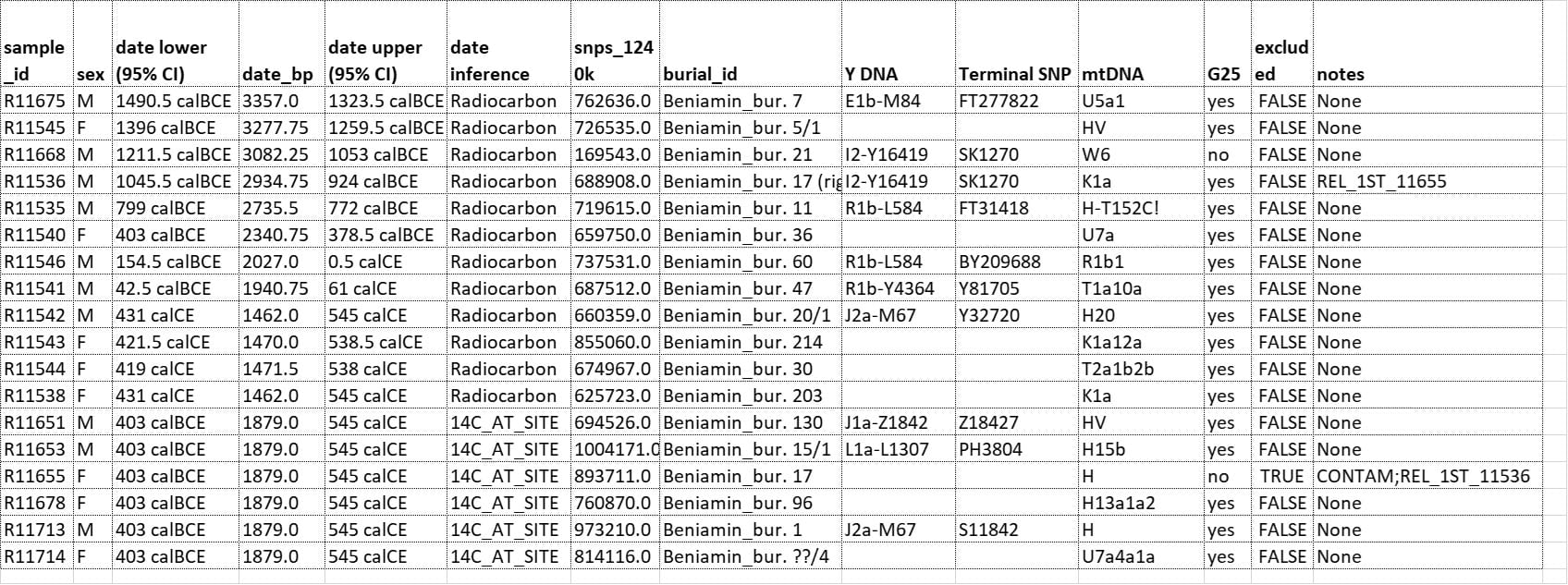
All data from Antonio 2022 preprint paper examining 17 samples ( the 18th sample was not included ) from Beniamin, in one table.

 All data from Antonio 2022 preprint paper examining 17 samples ( the 18th sample was not included ) from Beniamin, in one table.

All mtdna are from theytree site. While Y dna is double checked. Both citizen's and theytree assignments are taken into account.
Genome wide the situation in Beniamin reflects the same trends as in all Republic of Armenia (Etiuni). In LBA-EIA period with the Urartian period included there is a high level of Steppe ancestry. While in post-Urartian period we see a dilution of Steppe ancestry and an apparition of autosomes similar to modern Armenians.
The Y dna distribution has the similar trend. Strong presence of R1b, I2 with some E-M84 in LBA-EIA-Urartian period. And more diverse Y dna in a post Urartian period