When the tools and settings matters. Part 1
Friday, February 9, 2024
When the tools and settings matters. Part 1 and Part 2
Tuesday, February 6, 2024
Some remarks on a genetic shift that affected modern RoA in Iron Age.
Those are the possible events by their importance.
Wednesday, January 31, 2024
According to the link below this coin was minted by the satrap of Armenia Orontes ( Eruand ) who is mentioned in the Xenophon's Anabasis.
According to the link below this coin was minted by the satrap of Armenia Orontes ( Eruand ) who is mentioned in the Xenophon's Anabasis. He was "exiled" to Mysia where he minted these coins. Later he managed to return back to Armenia after organizing a rebellion against the Achaemenid king. The Pergamon inscription mentions him as son of Artašir. We have a thread about this inscription in this group. Links can be found in the comments.
See also
Friday, January 12, 2024
Koban culture 1200-400BC
This data was already published in a Russian paper, now it is corrected and translated in English.
Klin-Yar III:ID355 Lib2al Female 0.286153Zayukovo-3:ID72 Lib7al Male 0.042127 G2a1a1a1b1Zayukovo-3:ID79/1 Lib8al Male 0.449777Zayukovo-3:ID80 Lib9al Male 0.016644 G2a1a1aZayukovo-3:ID82/1 Lib11al Male 0.017636 R1b1a1bBratskiye 1-ye Kurgany:ID1402 Lib40al Female 0.338059
Saturday, January 6, 2024
Chalcolithic period cultures.
Chaff faced ware (4300-3500bc) was stretched from Cilicia to Caspian Sea. This cultural horizon is the common denominator of Minoan Y DNA and Maykop Y DNA. Their common ancestor.
Saturday, December 30, 2023
Unexpected ancient DNA results from pre-Islamic Bahrain.
Unexpected ancient DNA results from pre-Islamic Bahrain. They are different from modern day Arabs living there and plot close to ancient Mesopotamian samples from Iraq. On the PCA they plot just in the vicinity of ancient samples from South Caucasus, North-West Iran and North Iraq LBA. In this group we use the term "Central farmers" for this type of ancestry.
Lastly, we evaluate the ancestry of Bahrain Tylos individuals in a context of Near Eastern variation by estimating ancestry proportions using a previously published 12 three-way model with TUR_Pınarbaşı_EpiP, ISR_Natufian_EpiP and CHG as sources in a set of relevant ancient groups which can also be modelled in this way (Figure 3C) 12. In this model, the Bahrain_Tylos samples present similar ancestry proportions to AZE_ChL, Mesopotamia_PPN and IRQ_Nemrik9_LBA, IRN_Dinkha_Tepe_A, LBN_IA and to ARM_Aknashen_N. Accordingly, rank=0 qpAdm models show that Tylos-period Bahrainis form a clade with several of these ancient groups (p≥0.01; Table S6), suggesting that similar sources have contributed to their ancestry.
Tylos-Period Bahrainis are genetically closer to present-day Levantine populations than to present-day ArabiansRegarding affinities with present-day populations, the temporally aware model-based clustering analysis (Figure 1B) suggests that Tylos period Bahrain samples are more similar to present-day Levantine groups than to present-day Arabians or South Asians,
In order to gain further insights into the relationship of Tylos to present-day populations from the Arabian Peninsula and the Levant, we tested if the Bahraini samples form a clade with any modern population in our dataset using a set of reference populations (as outgroups) that can differentiate the different ancestries in the Near East. We found that Iraqis, Assyrians and Jewish groups from Iran, Georgia and Iraq could derive all their ancestries from Tylos-period Bahrainis (Table S8). Arabians such as Saudis, Emiratis and Yemenis have, in addition to ancestry from Tylos-period Bahrain, ancestry from East Africa, while Levantines such as Druze and Lebanese have additional Southeast European ancestry (Table S9)
See also
Tuesday, December 5, 2023
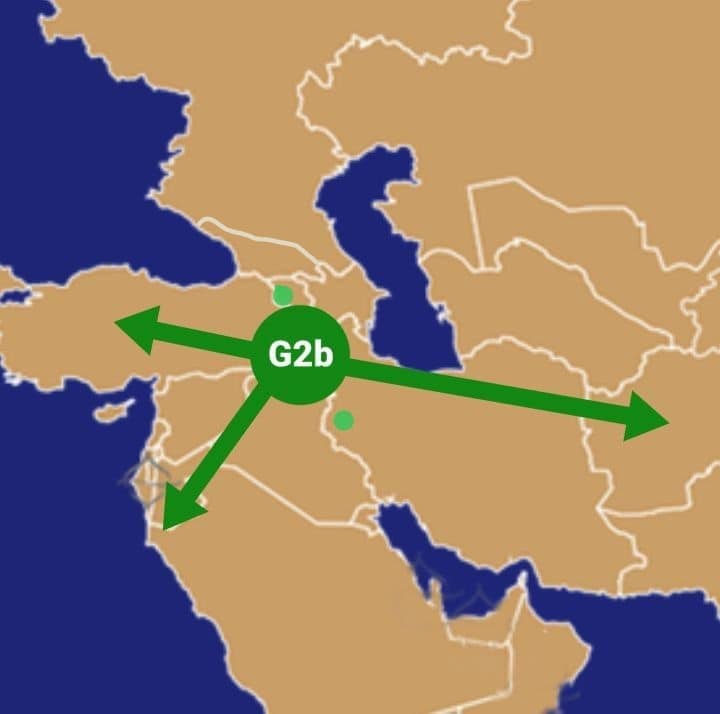
The genetic story of G2b
Thanks to Hovann Simonian we have a number of modern Armenian G2b on Yfull. Coupled with ancient DNA we can now have a better idea about the history of G2b.
- G2b1-M377 - This branch apparently was a Copper Age lineage. It is popular in Ashkenazi Jews and Pashtos in Afghanistan. Both are result of Current Era founder effects. The common ancestor of Jewish and Pashto clusters lived some 5500 years ago, so it is hard to say its real origin given the absence of aDNA from this branch. An Armenian from Syunik is present on basal position in this branch having a 8700-year-old common ancestor. https://www.yfull.com/tree/G-M377/
- G2b2a-Z8022 - It was found in Wezmeh cave in West Iran in a Neolithic period. Later another sample was found in Kaps (Shirak) from Kura-Araxes period (more than 5000 years ago). And finally, a number of G2b2a were found from Teishebaini (Karmir Blur) in later LBA and Iron Age period. Etiuni people had preserved some Y DNA from Kura-Araxes culture so the G2b2a was one of them. In most likelihood G2b2a was present in South Caucasus since the Neolithic era. See the second picture. An Armenian from Urfa and a number of Turks are from this branch. Their common ancestor lived 3200 years ago so it's probably represented an old migration of KA to Anatolia and a secondary expansion in Iron Age. https://www.yfull.com/tree/G-Y37100/
- G2b2b-FT36238 - There are no ancient DNA from this branch. There is a young 2600-year-old branch which apparently is an Armenian branch given the presence of Armenians there. A very distant 19000 years parallel branch is found in Kuwait. https://www.yfull.com/tree/G-FT36238/