Sunday, February 27, 2022

We have new regional data from Urfa

 We have new regional data from Urfa. Thanks to Sunshine Shoghig Shahinian who provided the files. The data was analyzed by Robert Navoyan and me.


1/ The first chart shows the closest populations to Armenians from Urfa. As expected the Armenian average is one of the closest. But Erzurum is slightly closer.


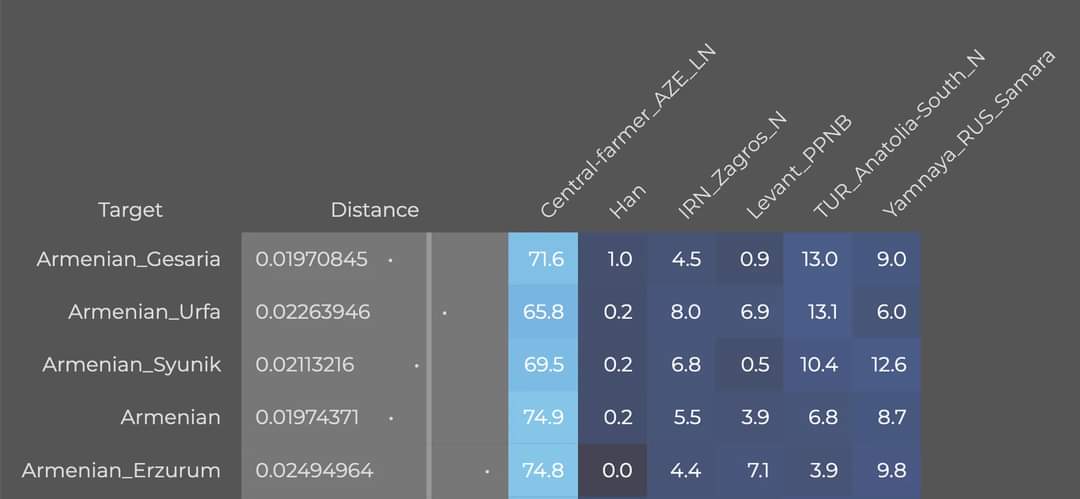
2/ The ancestry proportions in the second image shows that Urfa Armenians have similar structure compared with other subgroups. The main difference is the slightly higher South Anatolian Neolithic ancestry which is consistent with their geographic position. They have also lower Steppe which makes sense given the distance from Caucasian range. To my surprise they don't have extra Levantine ancestry. Their Levantine ancestry is equal to Erzurum ( from Javakhk ) levels which is quite interesting. Because it can mean that in the past Euphrates was used to move to North from Upper Mesopotamia. It's also consistent with the fact that the kingdom Dayene/Diaukhi in Nairi was initially in the south then moved to North toward Erzurum region. Though this result can be the consequence of earlier or later events.


3/ The third image is a PCA. Consistent with the previous analysis the Armenian_Urfa has a slight shift toward west/Anatolia and partly overlaps with Greek_Cappadocia. Despite similarities with Assyrians in Gedmatch the Urfa Armenians are not pulled toward Assyrians. 


4/ And finally we wanted to compare Urfa Armenians with an ancient DNA from Titris Hoyuk Early Bronze Age. This site is close to Urfa. Well it turns out that the closest modern pop to a local Bronze Age sample are the Urfa Armenians. This is a remarkable finding. It must be noted that this do not mean that no any migration occured since EBA. They almost certainly occured simply those migrants were not very different from Titris Hoyuk.


Also one should not confuse this result with the closest ancient DNA to Urfa Armenians. The closest aDNA to Urfans is still the South Caucasian Neolithic like for all other Armenians. This type of ancestry which we label Central farmers was present all over historic Armenia. And Cayonu008 sample showed that it was present near Urfa also since the Neolithic. But this a subject for different topic.


Distance to: Armenian_Urfa

0.03081703 AZE_Caucasus_lowlands_LN

0.03462119 IND_Roopkund_B_o

0.03468724 TUR_Arslantepe_EBA

0.03706614 IRN_Hajji_Firuz_C

0.03929593 TUR_Arslantepe_LC

0.04178189 TUR_Alalakh_MLBA

0.04550224 TUR_Ikiztepe_LC

0.05022027 SYR_Ebla_EMBA

0.05031025 TUR_Titris_Hoyuk_EBA

0.05114875 TUR_Ovaoren_EBA


PS I want also to thank Tsolig Shahinian for her activism.


Monday, February 14, 2022

Strabo reports that in ancient times there was a large lake ( sea ) in Araratian plain.

 Strabo reports that in ancient times there was a large lake ( sea ) in Araratian plain. It must be added that this is true. But it was in Neolithic times and not in Iron Age. Somehow the memory about this lake was kept. 

Then it disappeared. Maybe due to earthquakes? Who knows.

----


The Araxes also in Armenia, descending from the mountains, is said to have spread itself in ancient times, and to have overflowed the plains, like a sea, having no outlet; that Jason, in imitation of what is to be seen at Tempe, made the opening through which the water at present precipitates itself into the Caspian Sea; that upon this the Araxenian plain, through which the river flows to the cataract, became uncovered. This story which is told of the river Araxes contains some probability; that of Herodotus15 none whatever. For he says that, after flowing out of the country of the Matiani, it is divided into forty rivers, and separates the Scythians from the Bactrians. Callisthenes has followed Herodotus. [14]

http://www.perseus.tufts.edu/hopper/text?doc=Perseus%3Atext%3A1999.01.0239%3Abook%3D11%3Achapter%3D14#note-link15


Tuesday, February 1, 2022

The name Urdi is attested in Urartian cuneiform texts.

 The name Urdi is attested in Urartian cuneiform texts. It matches perfectly to Armenian word ordi (որդի) meaning son, offspring. This is a native Armenian word. Cognate of Greek portis and Sanskrit prthuka.


There was also a noble family Orduni whose name also could have been derived from the same root.


If this Urartian name is really related to the Armenian word this could mean that the p>h shift had already occured in Armenian language before Urartian period.


https://en.m.wiktionary.org/wiki/%CF%80%CF%8C%CF%81%CF%84%CE%B9%CF%82


https://hy.m.wikipedia.org/wiki/%D5%88%D6%80%D5%A4%D5%B8%D6%82%D5%B6%D5%AB%D5%B6%D5%A5%D6%80

Thursday, January 27, 2022

We have Syunik regional files in G25 format

 We have Syunik regional files in G25 format.  Special thanks to Mher Ishkhanyan for providing the files and Robert Navoyan for his perseverance for pushing forward the process.

I updated the Davidski's standard model for our purposes. I added two new pops Central-Farmers and CHG. And removed the Kura-Araxes because it's a late and composite pop.


Syunik Armenians are close to other Armenians. Which is another evidence that modern Armenians are quite tightly connected to each other people. 

They have their own peculiarities which were partly predicted in my Gedmatch analysis. They have slightly more Steppe and less Levantine affinity than the average. This difference almost certainly is the distant echo of Iron Age situation, and do not represent any important recent event. 

Events that could have affected Syunik gene pool in post EIA historic times are the influences from Iran, which is well known.  You can notice higher Zagros. It is this high Zagros coupled with Steppe that makes Udi closer to Syunik Armenians and not the CHG. As one can easily note Udis have quite low CHG compared to Daghestani speaking Laks. Which once more confirms the fact that current Udi gene pool do not represent a genuine Daghestani ancestry. 


Finally I add the RISE397 sample from EIA Syunik just prior Urartian expansion. The main changes that occured in Urartian and later periods are the increase of Zagros and Anatolian ancestry in Syunik at the expense of Steppe. In most likelihood this change is due to mysterious Biainili people influence.


Target: ARM_LBA:RISE397

Distance: 3.5825% / 0.03582465

67.6 Central-farmer_AZE_LN

27.8 Yamnaya_RUS_Samara

1.6 IRN_Zagros_N

...

0.4 TUR_Anatolia-South_N


And Etiuni, Lchashen.


Target: ARM_LBA

Distance: 2.1074% / 0.02107436

60.6 Central-farmer_AZE_LN

30.4 Yamnaya_RUS_Samara

5.0 GEO_CHG

1.6 IRN_Zagros_N

0.8 TUR_Anatolia-South_N

....


PS Syunik average was made with 11 samples.


Wednesday, January 19, 2022

The possible homeland of Kartvelian languages.

The excerpts are from Klimov's Etymological dictionary of Kartvelian languages. The proposed age of Proto-Kartvelian divergence is 4200 years before present. Others proposed slightly higher ages. Anyway, it's safe to assume that it occurred in Bronze Age.

The first separation are Svans. Later Zan languages separated from Georgian (or Kartli ) at 2600 years ago. While in medieval period Zan itself splits to Mingrelian and Laz. 

Georgian was the language spoken in historic Iberia. Which in medieval period expanded thanks to the emergence of unified Georgian kingdom under the rule of Bagratids. 

With current genetic and archaeological data combined the most likely place of proto-Kartvelian divergence might be in Western Georgia in Bronze Age. Where they were dwelling before Bronze Age is a different subject. But in most likelihood their ultimate origin is in Fertile Crescent.

Gamkrelidze proposed a slightly Eastern homeland, but current genetic data do not support that. First, we can't place their divergence homeland in Eastern Georgia because in western Georgia there is no steppe ancestry, while eastern Georgia might have a substantial inflow of steppe in MBA. If a migration from east to west occurred in MBA or later that would definitely have left genetic traces.

The other reason is the archaeology. Eastern Georgia had Kur-Araxian culture in EBA and Trialeti-Vanadzor culture in MBA. None of this culture fits well for the Proto-Kartvelian homeland. Even though a Kartvelian presence can be imagined in the Kura-Araxes but the strong presence of J1 popular in Nakh-Dagestani people imposes some geographic limitations on the possible presence of Kartvelian in Kura-Araxes.

Some believe that proto-Kartvelian homeland was more southern toward Anatolia. But that's also not feasible. Given that modern Western Georgians have excessive affinity to Eneolithic western Caucasus (CHG rich) and less to Anatolia. Should an important migration from south to north occurred that would have left more Anatolian ancestry in Georgia than its present today.  Also, their popular Y DNA do not fit this theory.

In sum we are left with the only one solution. To place them in Western Georgia. 

Nevertheless, this theory is not without problems. Because in western Georgia there is also evidence of ancient NWC like onomastic. Gamkrelidze mentions evidence of NWC like substrate in Svans. Also, there are very few hydronyms with obvious Kartvelian etymology. One of such a Kartvelian name according Klimov is Chorokh which appears in Greek sources later than the Akampsis/Boas names. 

One solution to overcome those contradictions is to imagine that NWC related groups were initially more prevalent in coastal regions while Kartvelian were in mountain regions of Western and Central Georgia. Later they expanded toward coastal regions, while another group formed the Iberia. 

See also


Saturday, January 15, 2022

Urartian hieroglyphs

 Urartian hieroglyphs. (first column)

Urartu used not only cuneiform writing system but also hieroglyphic. They were similar to Hittite-Luwian ( first picture second column) but not identic to them. 

The script is not deciphered. But some basic understanding what they represent is known.


Some of this (not all) symbols reached Medieval Armenian period. A set of symbols were used for short writing called Meaningful Symbols (Նշանագիրք Իմաստնոց). The last column of first image. Although Acharyan was critical about the idea that those symbols were directly from pagan times. 


The map represents sites were those hieroglyphs were found. Luwian hieroglyphs ( rectangle ) are mostly west of Euphrates. While most of Urartian hieroglyphs are found in modern Armenia ( Etiuni ).


Wednesday, January 12, 2022

List of geographic terms attested in Hittite cuneiform texts.

 List of geographic terms attested in Hittite cuneiform texts.

Some names have multiple variants. With somewhat different suffixes. Some roots can create different toponyms. Like the wiyan meaning wine.


But the most important thing is the absence of such a term as Azzi-Hayasa or Hayasa-Azzi in cuneiform texts.

Both terms are separate with their own determinant URU. Forlanini do not use Hayasa-Azzi but mentions them separately claiming that Azzi was a different name for Hayasa introduced in Mursili 2 period. He treats them as synonyms of same kingdom. 


They are other interesting toponyms there that I will discuss later.


https://cuneiform.neocities.org/HGN/list.html